
The title is, of course, an homage to Nancy Drew. But this blog post isn’t about girl detectives; it’s about coincidence, family, history, curiosity, politics, and sorrow. (Are you hooked yet? That’s the purpose of an introduction.)
The family part comes first. Mark and I are currently in Indianapolis, visiting our daughter Mary. A couple of days ago, Mark received an email from one of his uncles. This fellow is the family genealogy buff, and he wrote about discovering that their shared many times great-grandfather was buried in Indianapolis. Thus, coincidence.
Apparently said many times great-grandfather, Wiley J. Hendon, was a Confederate soldier. He served in the Clark’s 14th Infantry during the Civil War and was captured. Hendon was sent to a POW camp here in Indy. He died there on April 1, 1864 and was buried in a wooden casket in a field with other POWs. Seventy years later, the POW graves were moved to a different cemetery. By that time, the remains could not be identified, so they were interred in a common grave. According to Mark’s uncle, the city erected a monument to the dead Confederate prisoners in a local park and put up headstones with the men’s names and information in the cemetery where they were buried.
Naturally, we were curious. Mary was at work, so we drove out to Garfield Park to find the monument. The internet provided a handy picture of the monument and stated that it, fittingly, I guess, was close to the Southern Street entrance. But we couldn’t see it anywhere. Finally we stopped and hiked over to ask a young woman who was watering a bed of flowers. “Oh,” she said, “It’s not here any more. They took it away a couple of years ago. It’s in a warehouse somewhere, and all that’s left is a circle and some random boxwoods.” She gestured towards a road. We thanked her and walked back to the car, processing the fact that Mark’s family, our children’s family, was now part of a hot contemporary political debate about removing Confederate monuments from our public spaces. We did find the empty circle and the random boxwoods, by the way.
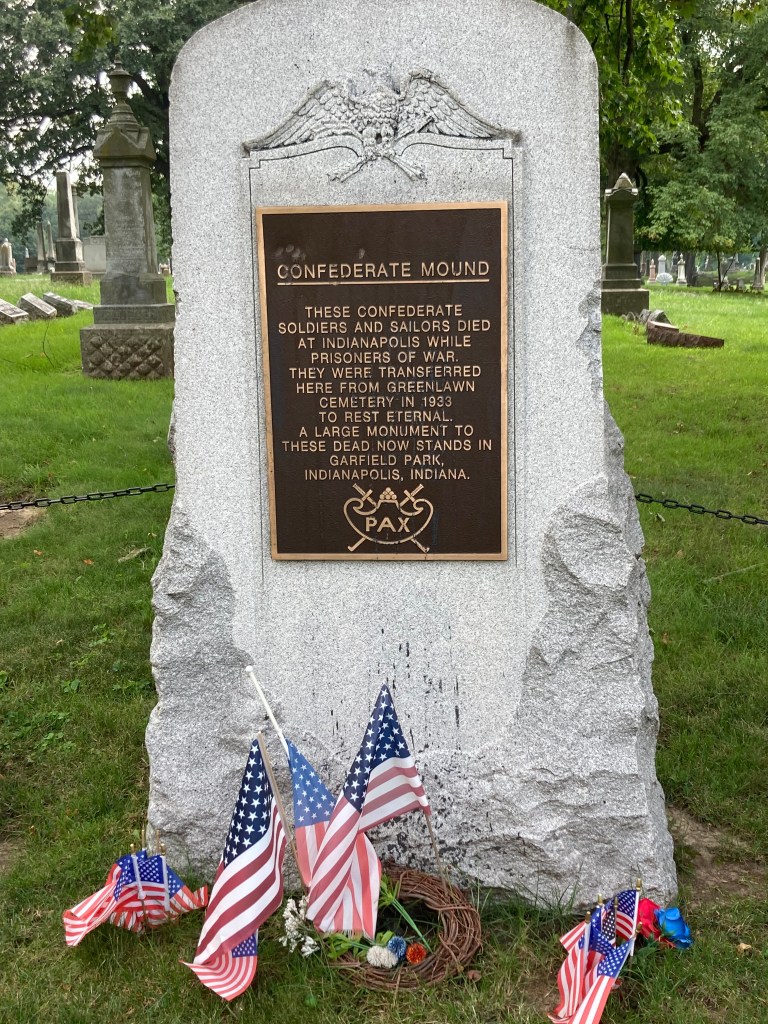
Humor helps. After making the requisite Raiders of the Lost Ark jokes about artifacts in warehouses, we drove to the Crown Hill Cemetery. Our online guide let us know that the gravesite was near Benjamin Harrison’s memorial, so we followed the signs there and soon found the Confederates. The pictured memorial – ironically surrounded by American flags – marks the site of several ground markers with prisoners’ names, regiments, and dates of death. Included on the listings were two “Negro servants” whom I suspect we were enslaved men. The regiments are sorted by state, so we found Wiley without too much trouble. We stood there for a bit, in the shady, peaceful spot marking the grave of so many men who died as a result of cruelty and violence.
By the way, Benjamin Harrison’s memorial is very nice. Apparently the local Garden Club keeps it supplied with flowers and a wreath.
So here we are at the sorrow, folks. Let me be clear: neither of us is sorry that the monument in the park is gone. History has not been erased; it’s been put right. No one should glorify the Confederacy or the people who fought for it. The men who died in its service are named and buried, part of the national tragedy that is the history of race in America, and they serve as an object lesson in how not to treat other people. That, and the fact that my precious Mark wouldn’t be here if not for the man in that grave, is Wiley’s legacy.
So Mark and I agree that we’re sorry that our ancestors held people in slavery, that they lived in a society where that action wasn’t just normalized but was seen as an economic necessity and a mark of prestige. And although neither of us feels responsible for those people’s choices, we do feel responsible for doing our bit to change contemporary racial dynamics. And part of that is saying here that we’re people affected by the removal of the Garfield Park monument, and we applaud that action. And I’m glad that the cemetery is there, so that we can know a little more about the family before us. Rest in the peace you denied others, Wiley.
 Kathy and Mark’s Frolic and Detour