
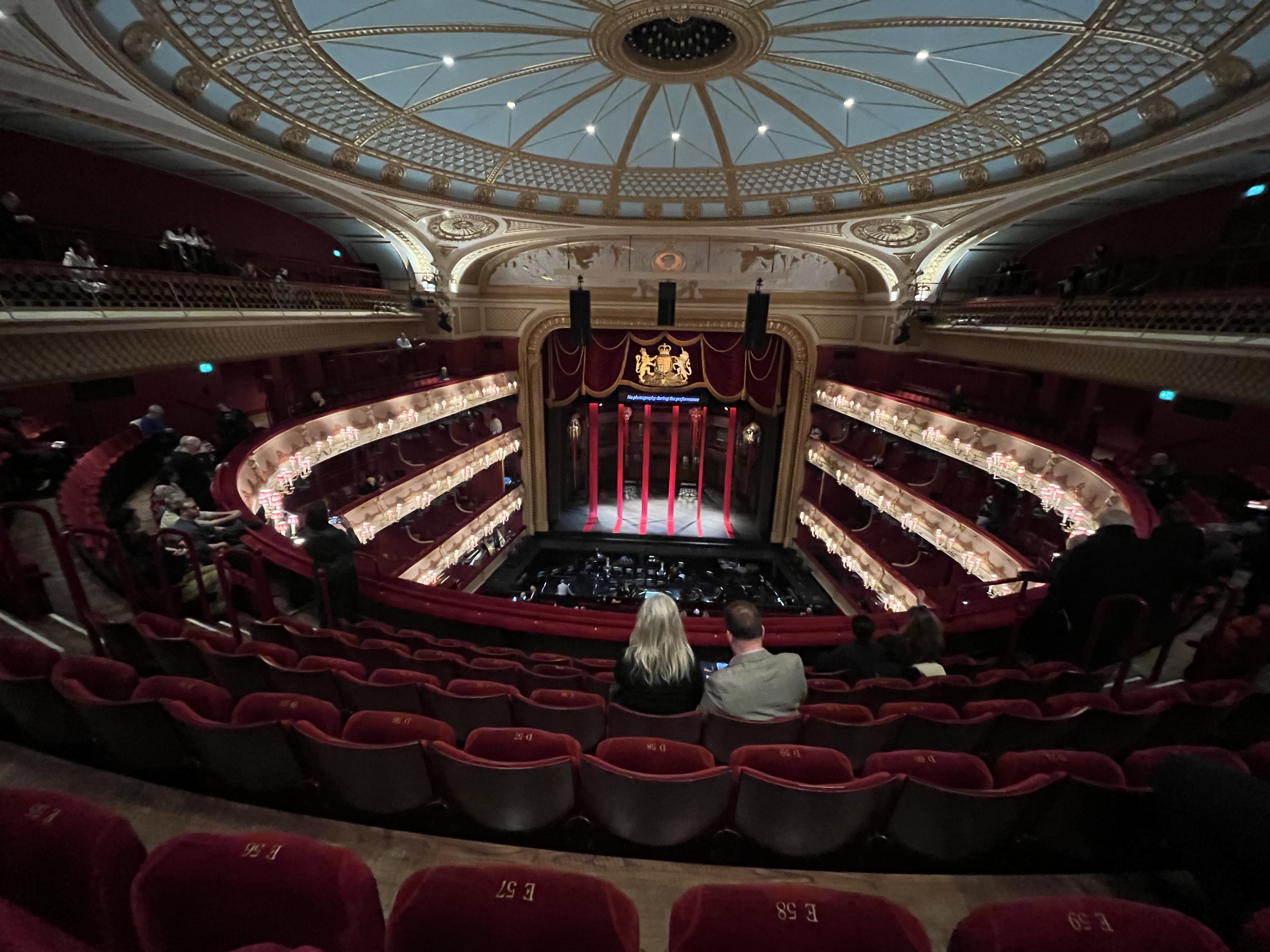
This year I got a spectacular birthday gift from my dear husband: a trip to London to see “Turandot” at the Royal Opera House in Covent Garden. (Mark and I share a love for opera, so it was fun for him, too.) Going to an opera in one of the great houses was a magnificent experience; I’ve shared a picture to give you just a peek at the opulence and grandeur of the place.
Now, I know that lots of people don’t care for opera. The plots are ridiculous, they scoff, and the performances are over the top in terms of volume and staging. Characters randomly break into dueling songs and face the audience, not each other, as they communicate their thoughts and feelings. Stirring dialogue that comes down to “You will!” from him and “I won’t!” from her can last for several minutes. (You think they’d just do rock, paper, scissors, or go to counseling or something, but nope, they sing.) Or folks waste precious time rhapsodizing about trivial matters in situations where every second counts. In La Boheme, for example, a fellow who’s going out in the bitter Parisian winter to pawn his coat so he can buy medicine for the dying heroine pauses long enough to sing an aria of praise to his coat before heading off to try and save the woman’s life. Really, buddy, where are your priorities?
All of this is true. And yet….
I love opera not in spite of the fact that it’s absurd and flashy, but partly because it is. A good production combines great music and grand visual theater. Take our Tourandot as an example. The music ranges from high pomp (eg, princess approaching!) to lushly beautiful (the haunting “Nessun Dorma”) to the heart wrenching (the enslaved Liu’s song about sacrificing her life for a prince who once smiled at her). And all the while singers in colorful costumes are sweeping across the stage, the Emperor is descending from above on his golden throne, and (no kidding) acrobats are tumbling and somersaulting every which way. This is not reality – I’ve been to China, and it’s not nearly so colorful – it’s pageantry, and I’m as awed as a medieval peasant watching a king process through the streets.
To be fair, not every opera is staged as opulently as our Turandot was. We saw a performance of The Marriage of Figaro in Madrid that was disappointingly gray and restrained. The costumes were period 1930s, so no diva flounced out with a swirl of her sweeping skirts to head to her assignation in the garden, and no male singer could tear off his plumed hat in rage as he (mistakenly) rants about his love being unfaithful. It was a missed opportunity, that performance, and I hope that this ill-placed restraint never taints another production I attend.
So I love opera because it appeals to my eyes and my ears. But after Turandot, I got to thinking about how often we ignore the gifts our senses give us, and I’m always so grateful to be reminded of how much we can receive if we just remember to open ourselves up. Sometimes in the middle of the night, for instance, Mark will gently hold my hand for a few moments if we’re both a tiny bit awake at the same time. That short, simple touch pours love and comfort into every bit of my being. Likewise, the sweet taste of hot chocolate on a cold night or the first bite of minty ice cream on a hot one inspire joy and contentment, even if you’re not looking at what’s going in your mouth. And on a visit to the London Natural History Museum this week, we got to breathe in what scientists believe the atmospheres of some of Jupiter’s moons smell like. So Io and Ganymede and Europa were brought close to us earthbound creatures in a way that adds to the amazing pictures in the exhibition. What joy!
The upshot of the opera for me, then, was to remember that engaging as many of my senses as possible enriches my life and widens my perspective. And to know the world better is to appreciate it more and to find more to be grateful for. And that to me, just makes, well, senses.
 Kathy and Mark’s Frolic and Detour