What I did not expect to love

If you’re my Facebook friend, you may recognize this picture. It’s a photo of some pintxos we enjoyed in Bilbao. The potato dish is patatas bravas, which is what we’d call home fries covered in a thick, spicy tomato sauce. In the foreground is guacamole criss-crossed with anchovies. We devoured these delicious dishes in person, but the reception on Facebook wasn’t so positive. In fact, I gather that most people thought both dishes were, let’s say, objectionable. I get it; anchovies I’ve tried before have been gross, and ketchup, not tomato sauce, belonged on fries. But guess what happened? After trying both dishes, I loved them.

In all fairness, anchovies in Spain are fresh and not nearly as overpowering in taste as the ones I’d had before. Likewise, the brava sauce is delicious and ubiquitous; you buy it at the grocery store in squeeze bottles, like mustard or ketchup. But I still totally get why people would say yuch. I didn’t expect to love these dishes, but I did. In fact, it turns out I love a lot of things I didn’t expect to.

Take Mark as an example. We were set up by a mutual friend, a woman I worked with who knew one of Mark’s college buddies. Knowing men and women well, she mentioned casually to him that she had a friend (me) that she thought he’d have a lot of fun with. To me, she announced dramatically the next day, “I’ve met the man you should marry!” I admit that I was curious, so I asked what he was like. She looked me in the eye and stated firmly, “He’s a Republican Baptist from Baytown,” whereupon I asked her what she’d been smoking. “Just go out with him once,” she implored, and I did. Mark and I got married a few months later. I did not expect to love this man, but I did and do, although more now with the passage of time and the fact that he’s no longer Republican or Baptist. He’s still from Baytown, though.

More recently, I’ve discovered that I love sitting and watching the sea. Beaches have never been my thing; after about 20 minutes, I’m red as the proverbial lobster and have sand in places that sand was never intended to be. But lounging in a chair on our terrace and watching the Mediterranean roll by is now one of my favorite pastimes. I love watching the gorgeous, mild waves and appreciating the splendid hues of blue that change from moment to moment. (Admittedly, it does not hurt if wine is involved.) Enjoying Mare Nostrum seems to have increased my capacity for other sights as well. Hanging out in Madrid’s answer to Central Park, El Buen Retiro, was an absolute delight yesterday. Mark and I walked its shady paths and settled on a bench to watch a fountain spray into the sun and light glint off the tile and glass Crystal Palace in the park’s center. Our visit was lovely, and we only left because we needed to catch the train home.

I did not expect to love the sea, Mark, or anchovies. But I do. And I did not expect to love red wine with lemonade (tinto verano, which tastes a lot like sangria and comes in two-liter bottles at the grocery store now that summer is here), living in an apartment that’s a third the size of our old house in Austin, or not owning a car. But I do. That’s the nature of love, I suppose: it comes to you in things and people and experiences that you don’t expect. And you know what? I love that.


img_1219

Mona from heaven

According to my internet game Trip Trivia, an average of 320 baguettes will be eaten in France every second. Mark commented that this was all right as long as it was not by the same person, but it just confirms my impression that in France someone is always eating a baguette within two feet of you. What’s more, the baguette smells amazingly fresh and yeasty, and you must restrain yourself from doing a Jean Valjean and snatching it out of the hands of its hapless consumer and making a run for it. Since that didn’t go so well in Les Miserables, I try to content myself with telling my rumbling tummy that we’ll stop at the next patisserie.

Bread is not exclusive to France, of course. Mexico has tortillas (in Spain, a tortilla is a potato and egg dish, kind of like a frittata), and Russia has its rye bread. In the US, we have regional breads. Southerners have biscuits and cornbread. New Yorkers have bagels. There’s no reason you’d know this, but I never saw a bagel until I was a teenager. I lived in Beaumont, Texas, which is not noted either for its cosmopolitan nature or haute cuisine. But two friends had brought back bagels from New York, and I thought I’d died and gone to heaven upon tasting the chewy circle of perfect carbohydrates. I won’t tell you what I did the first time I had a bagel with cream cheese, lox, and capers. Some things are best left in the past.

Of course now we can get different kinds of bread all over the world. You can get bagels even in Beaumont and Mexican tortillas in Torrevieja. But Mark and I have run into a couple of new carbs here that are worth noting. One is a sweet cake called an Anguila, which we saw in Madrid and is like an elaborate fruitcake in the shape of an eel. I didn’t try it for fear that the shape would make me feel a little eel. (Ba-badum-ching!) And over Holy Week, Semana Santa, we’ve been introduced to monas de Pascua. These Easter cakes are basically cakes that taste a lot like king cakes (more on them later) but with a hard-boiled egg baked in the middle. Seriously, it’s an egg. I don’t know if there’s a special way you’re supposed to eat it. Mark and I just extracted the egg, peeled it, and ate it along with the cake. Apparently it’s traditional for godparents to give monas to their godchildren, who eat them on the Monday after Easter, or the Día de las monas.

Monas seem to be everywhere here during Holy Week. That seems fitting on some level. After all, the bready cake calls to mind the communion bread of Maundy Thursday, the day before Good Friday when the Last Supper occurred and Jesus instituted the ritual of Communion. And eggs are always around at Easter. As a kid, I loved dyeing eggs. Presumably the desire for this activity was carried on the second X chromosome, because my father and brother were nowhere to be found in this process. But my mom and sister would participate, at least until my sister became an angsty teenager and insisted on dyeing her eggs black and gun metal gray. After that debacle, it was just the Mom and Kathy show, costarring however many eggs I could persuade her into sacrificing for Easter fun. My mom was a great Easter bunny, at least until the year when she hid an egg in the control panel of our living room’s air conditioning unit. No one found the egg during the hunt, and Mom forgot she’d put it there. Even hard-boiled eggs eventually turn rancid and smell. Trust me on that one. Don’t try this at home.

But let’s return to the present day. The monas were yummy; as I said, they tasted a lot like the king’s cake you eat on Fat Tuesday right before Lent starts. As we’re eating our new-found Spanish treat, Lent ends. This all seems so perfectly cyclical that I went looking to see whether those two delicacies are related. I didn’t get an answer on that score, but two interesting pieces of information did crop up.

The first piece was the explanation of the presence of the egg. It’s not just about the symbolism of new life and breaking through death (as well as Spring fertility rites, thank you, pagans); it’s also about hunger. Lent is traditionally a time of repentance and abstinence, and Catholics were supposed to give up meat and eggs. People continued to collect eggs during Lent and hard-boiled them to preserve as many as possible. On Holy Saturday, people brought these eggs to church for a blessing, which presumably included a casting out of ptomaine poisoning. (On a related note, the Lenten fast gave rise to another ritual celebrated just after Easter. It’s called “The Burial of the Sardine,” and it involves people parading, because it’s what you do here, and then, well, burying a sardine. Apparently everyone is sick of fish by this point, so it’s goodbye sardine, hola hamburguesa.)

The second piece of information that caught my eye was the origin of the word “mona.” Apparently it comes from the Arabic word munna, which means “mouth provision” and was a type of gift given to a Muslim lord. Other etymologies also go with munna but specify Morocco as the geographical origin and say the word simply means “gift.” But since Easter keys off Passover in many ways, and Passover is followed by the Jews wandering in the desert for 40 years. I couldn’t help hoping that maybe the monas and the manna the Jews ate during their wanderings were related. Arabic and Hebrew grew up as next door neighbors, so it’s not impossible.

In the interest of full disclosure, I must say that nothing I could conjure up on the internet supports my theory. The etymology of the word “manna” appears to be the subject of some dispute and probably a lot of Doctor of Divinity dissertations. So who knows? Wandering in the desert for more than about 40 minutes doesn’t sound like fun to me, but eating manna does. So until something definitive comes along, I’ll content myself with my little theory on Holy Monday and enjoy my mona from heaven.


img_0050

Our Ladies

Spring has come to the Costa Blanca. Temperatures are rising, shops shuttered for the off season are reopening, and many lobster-colored Germans are letting way too much hang out on our beaches. So far, the best thing Spring has brought Mark and me is our first visitor since we moved here. Her name is Joyce Lowe, and the three of us appear in the selfie we took in the main market in Madrid. Some of you have probably already seen this photo on Facebook.

Joyce and I met when she was my student at Saint Mary’s University School of Law. I remember that her paper in an Environmental Litigation seminar I taught was about whether “existence value” is a compensible component of environmental damage. In other words, people are happy to know that the Grand Canyon is out there being spectacular, even if they never travel west of the Mississippi. That’s existence value. Assume that some jerk comes along and causes enough environmental harm so that the Grand Canyon no longer exists. Can the government  sue the jerk for damages because the Grand Canyon’s existence value is gone? It’s an interesting question.

Anyway, that was a while ago, but happily but Joyce and I have remained friends via visits, emails, and Facebook. She practices law now in San Angelo, so I don’t see her much, but Mark and I were delighted when she asked whether she’d be welcome in Spain in April. Of course the answer was yes!

We met her at the airport in Madrid, which we’ve visited a couple of times but which was new to Joyce. Having proceeded to our standard new-to-the-city stop, the hop on/hop off bus, we bundled ourselves into our parkas and made the circuit of the city. Over the next two days Joyce was a trooper as she dealt with jet lag while seeing El Puerto del Sol, Plaza Mayor, the Cathedral, and various other attractions. My favorite two were the Museo Nacional Centro de Arte Reina Sofia, where Picasso’s stunning Guernica seems as relevant as it was in 1937, and the Palacio Nacional.

Actually, the visit to the Palace could have been a bust, as the building was closed so that the King could receive a visitor. (I’m guessing he did not put out the towels for his guest, as I had done for Joyce.) More than compensating for our inability to enter the Palace was the parade that took place to usher the dignitary in to see the King. Guards in shiny breastplates and wearing red coats and white-plumed hats marched about, and two gorgeous red and gilt coaches that would have made Cinderella proud wheeled into the courtyard. Only one carriage had a footman, but what attendants there were and both drivers had on splendid red and gold livery and – get this! – powdered wigs. We gawked and pointed and took zillions of pictures. My favorite picture is of the Captain of the Horse Guard astride his stallion and talking on his cell phone. Undoubtedly his wife was calling to remind him to pick up a NICE bottle of wine on the way home, because his brother Enrique and his snooty wife were coming to dinner and God only knows if the wine wasn’t good Enrique’s wife would say something to him, and he’d repeat it like a parrot without a brain to his mother, who would say something nasty next Sunday dinner at her house where, by the way, SHE served crummy wine.

After a couple of days in Madrid, we took the train back home. We spent the next couple of days exploring Torrevieja, including walking on the beach, visiting the local salt works, and seeing the lovely Palm Sunday procession. Cartagena also was graced by our presence; seeing the 2,000 year-old Roman amphitheater is always a treat, especially if you sing “The Eyes of Texas” on the stage to a variety of bewildered tourists. We also visited the Moorish/medieval castle and took in an exhibit about Queen Isabella. I have to admit, I’m a big fan of her clothes but not so much of her politics. Expelling the Jews and the Moriscos – Muslims who had converted to Catholicism after the Reconquista of Spain but whose religious allegiances were always suspect – smacks of a purity cult and not the faith I understand Jesus to have preached. Wait, there’s that pesky relevance thing again!

We spent our last day in Elche, a city slightly north of here, visiting yet another fortress and wandering among palm groves that are designated as a UNESCO World Heritage site. After lots of hugs, Joyce boarded her train to Barcelona at the station in Alicante. And we came back to our routines, which are happy and peaceful. As I write this post, Mark and I are sitting on our balcony, watching the sunset and the sea and drinking tinto verano, a mixture of red wine and lemonade that you buy in two-liter bottles in the soft drink section of the grocery store.

But go back to last night, when I was goofing around on Facebook and saw the horrific news that Notre Dame was on fire. I know that Black churches burn and synagogues burn and mosques burn, but just for now I’m focused on Notre Dame. We’ve visited this phenomenal building twice, once as a couple and once with our daughters. Each time, I’ve experienced a sense of rightness in that building that’s intense and powerful and impossible to explain. It’s like my DNA wants me to be there; I feel settled and at home. Maybe it’s my French blood calling to me. According to family lore and some fairly suspect genealogical research, my mother’s ancestor, John of Crécy, joined William in 1066 to see what trouble he could make in England and, I suspect, to avoid his creditors. You know the drill – 1066, Hastings, arrow through eye=dead English king. John of Crécy morphs into Englishman John Cressey, and Cressey eventually morphs into Crissey, my mother’s maiden name.

So who knows? Maybe Notre Dame is in my DNA. Maybe my ancestors worked on the cathedral. They were undoubtedly not the upscale skilled artisans carving the magnificent stonework or designing the ingenious flying buttresses, but after much hard work they could have been promoted to Assistant Drudge and allowed to carry the rubble to dump into a pile. Or maybe they worshipped there, standing inside the cold stone walls and gaping in stupefaction at their magnificent surroundings. I feel it, too, ancestors. You know how Catholics talk about veneration? I’m a little fuzzy on what they venerate as well as what you actually do when you venerate something. But I do know that staring at the front Rose Window is probably as close to veneration as I’m ever going to get.

And all of a sudden we’re watching this burn in real time on my iPad.

Damn it, I kept thinking, Notre Dame can’t burn! I need it to exist, to know that it’s there. It’s like you need to know your family and friends are there, even when you don’t see them for long stretches. You need to know that the Mona Lisa still smiles and the mother in Guernica still mourns her dead baby. You need to know that Beethoven’s Fifth still starts with “Da da da DA” and that the bluebonnets cover the fields of Central Texas and then give way to the hot weather Mexican Hats. I need these things, and I’m grateful for them. Maybe existence value is a way of saying that we all need something, someone, to be grateful for.

Today I’m grateful that some of Notre Dame remains, including my beloved Rose Window. Rebuilding is promised while mourning for the terrible losses continues. Today we are Tennyson’s Ulysses, contemplating another voyage in his older years and grateful for what he has left of his body and his dreams: “Though much is taken, much abides.”

So today, friends, be aware: I’m grateful for you. You have value for me purely because you exist. And because I couldn’t begin to name all of you in my thanksgiving, I’ll let our ladies – Joyce and Notre Dame – stand in for all of you. I’m more grateful for those two than I can say. So, as they say in church, thanks be to God. Amen.


img_1126

Accent on privilege

An American couple, a New Zealand couple, an Irish couple, and an Anglo-Indian couple walk into a bar. It sounds like the beginning of a joke, right? But actually it’s how we spent a good part of our afternoon yesterday, sitting in a bar with the aforementioned three couples, listening to music, singing karaoke, and just generally having fun. The one small fly in the ointment was that the announcer for karaoke was apparently from the north of England and therefore utterly incomprehensible to everyone at our table. One of our Kiwi friends leaned over and reassured me, “At least I can understand your accent!”

Wait. I have an accent?

In fairness, it’s not the first time someone has referred to my accent. Mark and I have been participating in a weekly study group run by the church we attend here. A couple of weeks ago the leader asked if either Mark or I would read the scripture. I quipped, “Are you sure you can understand our accents?” The very kind group members quickly answered that they could and that, in fact, they thought our accents were very cute. My first thought was, this is coming from people who pronounce the longest of the prophetic books in the Bible as “Eye-zeye-ah!” But I read and, mulling it over later, realized that accent, like beauty, appears to be in the eye of the beholder. Or in this case, the behearer.

Now, let’s be realistic: Henry Higgins may have been fictional, but he knew a truth about human beings. Our speech goes a long way towards defining us, and people learn about us from how we speak, as well as what we say. He also knew that the English have accents. The accents may run the gamut from sexy to annoying, but they exist. In all fairness, the English also have some very handy words. Take “sort” as an example. You can sort something by fixing it, buying it, reserving it, arranging it, dealing with it, or figuring it out. That’s a handy verb, and I’m all on board with sorting. However, they also have their odd words. One group in the congregation here solicited items for a tombola. God and the English only know what that is. And, sadly, there is no “English to American” setting on Google Translate.

But I digress. Back to accents. This whole question of accents rings my bell partly because of my mother, God rest her soul. A dearer, more loving, more accepting person you’d be hard pressed to find. But among her few prejudices was a deep seated dislike of Southern accents. (This no doubt complicated life with my father, who spoke with a pronounced Southern accent. But, as they say, not my monkeys, not my circus.) A native of Wisconsin, Mom was dragged from her beloved home state at the vulnerable age of 13 and was plunked down in the middle of a junior high class in Austin, Texas. She noticed two things immediately. One, all of the girls had two names (Emily Ann, Sarah Elizabeth, Mary Lee – you know the drill). Second, all of the girls had Southern accents of the kind that allowed them to say, “Bless her heart, (insert insult here).” Mom did adjust and make some lovely friends, but the experience left scars. So when my siblings and I were growing up, we learned to speak like Mom and eschewed practices such as dropping the g off -ing words and speaking as though we were getting paid by the syllable. (“Cay-un y’all pah-us the jay-um?” is actually a breakfast sentence composed entirely of one-syllable words, in my world.)

Now over the years, I’ve softened on this issue. I’ve adopted “y’all” because English neglected to add an analog for “vosotros” (second person plural, informal) when it went on its periodic linguistic raids into German, French, Spanish, and every other tongue it ever encountered. I also don’t automatically assume that people with southern accents secretly mourn the failure of Pickett’s charge at Gettysburg. But I’ve clung stubbornly to my nondescript American speech. All of those years of trying to sound like Walter Cronkite were not wasted effort. And yes, I do know that Walter Cronkite was from Texas. I rest my case.

So when English speakers here tell me I have an accent, it’s still a bit of a shock. And I’ve realized that this is the shock you feel when you recognize your privilege. To me, how I speak was the norm. It was more than the norm; it was how you spoke correctly. Other manners might be charming but were slightly off plumb. But I’ve been booted, firmly but lovingly by my Kiwi and English friends, out of my pronunciation comfort zone. I recognize that my accent is a piece of how I experience privilege, and I want this realization to open me up and make me more aware and more open minded. I hope I’m a better person for that realization. I hope it helps me recognize all of the other privileges I take for granted.

I’ll let you know as soon as I sort that one.

marketing man person communication
Photo by Gratisography on Pexels.com


Cast down your bucket where you are

When I was a kid, I read a biography of George Washington Carver. In it, the author recounted a speech by Booker T. Washington. In this speech, Washington told the story of a ship on a South American shoreline. The ship kept sending emergency messages asking other ships for drinking water. A responding ship messaged back, “Cast down your bucket where you are.” After a few frustrating rounds of this exchange, the first ship reluctantly let down a bucket and came up with fresh water from the Amazon river. The water they’d needed had been there all along.

I’ve read about this speech subsequently and confess that I don’t grasp its significance in history. Several websites say that it was addressed to freed slaves to urge them to stay in the South, while my book said it was addresssed to local business owners urging them to hire the freedmen. But I do remember clearly the impact the quotation had on me. It told me to look to what’s actually available instead of casting about for resources or talents that aren’t there. Work with what you have, instead of pining for something that you lack.

So what does that have to do with a picture of Mark and me goofing around in plastic Viking helmets? The answer is that this picture was taken on the Viking Tour in Dublin, where we visited last weekend. The city is lovely, and the tour was both hilarious and totally touristy. We embraced our not-so-inner tourists and wore our helmets proudly for the duration of the journey. We roared at our enemies, the Celts (i.e., tourists on competing companies’ buses), and laughed at the truly terrible jokes our guide told. I briefly considered how one might do the YMCA motions with the helmet but decided not to try for fear of putting out Mark’s eye. Any dignity we might normally possess got to take a breather and go have a coffee, kind of like the goalies for Real Madrid do when that team plays a lopsided game.

Let me hasten to add that we took in more sophisticated fare than this tour. We saw St. Patrick’s Cathedral, with Jonathan Swift’s legacy as much in evidence as St. Patrick’s. We goggled at the intricacy and beauty of the Book of Kells and the bookish grandeur of Trinity College’s Library. St. Stephen’s Green offered a lovely respite from the bustle of the city center. The displays of gorgeous gold ornaments and distorted, wizened bodies buried in bogs topped off the wonders in the National Museum. And thanks to our delightful friends and hosts, Kathy and Martin Langan, we had a fun pub night complete with Irish folk music and dancing, a trip to adorable Kilkenny, and tours of two castles – not to mention a comfortable place to stay, delicious food to eat, and lots of genial conversation.

But as adult as all of this sounds, we’re still embracing our tourist personas when we travel. And we’re dancing with, at least in my case, more gusto and abandon than skill and grace. We’re trying new food and drink even when they’re messy – I’d heard of a milk mustache, but a Guinness mustache was a new one to me. Apparently it’s a thing. We’re playing air guitar and practicing percussion on the tables when we go to bars to listen to loud, fast music. (Note: Do not, however, use a napkin dispenser for a drum. They explode. Don’t ask me how I know, but I swear it wasn’t me.) And we’re speaking dreadful Spanish to what must be the most linguistically patient populace on the face of the Earth.

In other words, we are casting down our buckets where we are. When you hit your sixties, you realize that you don’t have time to be anyone else besides yourself. There is nothing left to prove. It’s just you and the bucket and the Amazon- or, in our case, the Mediterranean. So if there’s a little too much giggling in our videos or too much goofiness in our pictures for your taste, please bear with us. We are drinking the water of our lives, fully and joyfully, till it runs down our faces and soaks our clothes. And we are more grateful than it’s possible to express for the opportunity.


img_1395

My favorite things

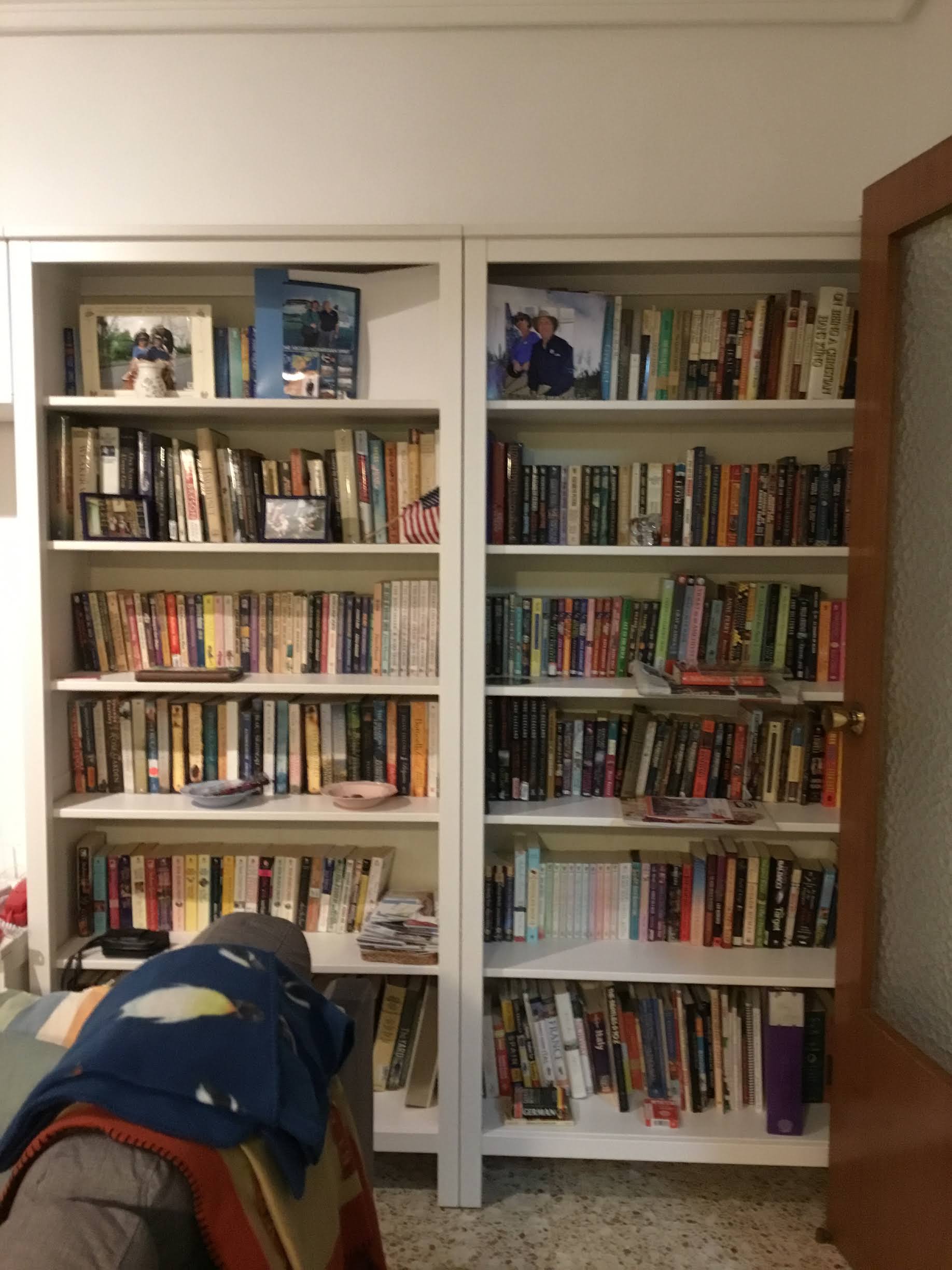
img_0041We’re in Spain, not Austria, but we share a sentiment this week with Maria von Trapp. We love our favorite things! Our 29-box shipment has arrived from the US. As a consequence, we now have full bookshelves (see picture), great kitchen knives, and all of the seasons of the original – read, best – Star Trek DVDs. Life was good before, but now it’s even better.

As you know if you’ve read previous blog posts, we’ve been waiting for some time for this shipment to arrive. Last December, movers came and picked up our boxes in Texas. Tracking was spotty at first, and we arrived in Europe well before our belongings did. Having hauled bags that were stuffed to the gills, we’ve done fine on clothes and shoes, and because our apartment has been in a rental pool, we’ve had plenty of furniture, kitchen goods, linens, and the like. But we’ve been missing some of our domestic treasures, and getting word about our things finally embarking on their transatlantic voyage was a great relief. About three weeks ago, we were notified that we and our stuff were at last on the same continent. We happily filled out the shipper’s form, giving dates when we’d be out of Torrevieja and unable to receive the boxes. Then came radio silence. Zilch, zip, nada came our way, despite repeated inquiries on our part. Patience may be a virtue, but for me it’s a virtue that requires a glass of wine here or there to summon.

The wait began to come to an end, if that makes any sense, while we were in Valencia, on one of the days that we’d blocked out with the shipping company. A call to my cell came early one morning to tell us that the movers would be at our apartment later that week but while we were still in Valencia. Mark told the driver that this was impossible because we were in Valencia until Friday. The driver hung up, leaving us wondering if we’d find 29 boxes in the hall of our apartment building when we got home. Two days later, while we were still in Valencia, another driver called to say he was delivering our shipment THAT AFTERNOON. Since stress improves our Spanish so much, I think we told the driver that today was impossible. Apparently not being the philosophical sort who’d argue that today was indeed possible because we were all experiencing it, the driver did the next best thing. He hung up. Calls to the shipping company ensued, and we were assured that delivery was now set for next Tuesday. Happiness reigned, and we blocked out all day Tuesday to receive our 29 babies.

Monday morning, then, found us at a lovely little outdoor cafe, ordering breakfast and ready to dawdle over cafes con leche. And, of course, my cell rang. It was the movers, who announced in no uncertain terms that they would be at our apartment in 20 minutes. They presumably had learned from experience with us, because they didn’t wait to hear what was impossible this time. They just hung up. After a hurried spousal consultation, I ran back to the apartment. That left Mark to deal with a very confused waiter, whose impression that all Americans are crazy had just been heavily reinforced. But being a good sport, he packed Mark’s full English breakfast into one container and my fried eggs and toast into another. Mark raced home to find the movers on our doorstep. So slightly worse for the wear repasts and two young Spanish guys with more tattoos than I can count en Español arrived 25 minutes after the call, and in no time at all we had 29 boxes in the guest room and a wad of shipping paperwork in hand.

The unpacking process went smoothly, partly because we’d left lots of spaces empty in anticipation of getting our things. The dressers are now full, the closets are full but not jammed, and, most importantly, the bookshelves are stocked with favorites old and new. About the only item without a home is the knife set, but we’ll get there. The apartment feels cozier than ever, and we’ve done a fair bit of self-congratulating over the last couple of days.

That isn’t to say, of course, that there haven’t been some puzzles in the unpacking process. For example, we currently have in Spain five fingernail clippers. I assume that one’s down to me. While we were packing, I probably ran across said clippers and tossed them into a waiting receptacle. Rinse, lather, repeat – five times. But I’m not the only one who developed a wee case of packing amnesia. Mark appears to have shipped four pairs of binoculars and two monoculars. You can do your own math to determine whether four plus two equals five or six. Conversely, why didn’t I pack my nice set of hangers for the dresses and blouses in our shipment? And why did we ship the case to “Roger and Me” with no DVD in it? Life’s just full of little mysteries.

For now, I’m content to gaze adoringly at out old friends in a new place and let the comfort of familiarity seep into my bones. We are having the proverbial ball exploring new places. But having a bit of home here now with us feels mighty good.


Meeting Margarita

No, it’s not that kind of margarita. Get your mind off alcohol. This post is about a girl we saw during Las Fallas, an amazing annual festival in Spain’s third largest city, Valencia. In my mind, the girl is named Margarita. You’ll see why in a bit.

You probably haven’t heard of Las Fallas; we certainly hadn’t. I’m not sure how old it is. Records of it go back about 250 years, but the festival is probably more ancient than that. Reportedly its origins lie in spring cleaning combined with a kind of fiery voodoo. After a long ago cold winter indoors, the hut needed refurbishing and rubbish needed burning. You also may have had neighbors who’d gotten on your last nerve during that period of enforced closeness, and if an effigy of said neighbor happened to make its way into the rubbish fire, so be it. This all has evolved into a festival that draws thousands to Valencia every March. It’s Mardi Gras with more smoke and fewer boobs. As we were being swept along with a crowd, I told Mark that this experience reminded me of Times Square on New Year’s Eve. A fellow next to us laughed and said that this was better, because the weather is warmer and the beer only costs a Euro.

Part of Las Fallas is about fireworks. One giant display occurs at 14:00 (2PM to us Americans). Why shoot off fireworks in the middle of the day? The answer is that it’s all about the sound. The fireworks are launched in a city square, and the sound echoes off the buildings. You can feel the blasts in the sidewalk where you’re packed in with thousands of your new best friends, and at the big finale you actually feel the percussion in your chest cavity. The other giant display occurs at 1AM near the Alameda, a long park that follows the course of a dry riverbed. Those fireworks certainly boom, but the light display is what overwhelms here. It’s so bright at points that you think you may damage your eyes by looking at it, but the spectacle is so compelling that you can’t look away. On a much more human level, kids carry around wooden boxes of mischief and happily snap firecrackers on the pavement. Bigger kids carry around cherry bombs and bottle rockets and have been known to toss them at the feet of unsuspecting tourists. Las Fallas is not a festival for the nervous.

Another significant part of Las Fallas is the creation of a large statue of Our Lady of the Foresaken, which I take it is an iteration of the Virgin. The statue, which is located next to the cathedral, is made of slats on a frame. Local groups of men, women, and children dressed in traditional 18th century garb – think poofy silk patterned skirts and lace overskirts and mantillas for the females, for example – parade through the streets with the group’s banner at the front and a band at the back. The parades undoubtedly conjure up Spain’s past, but modernity makes itself known as well. Several lovely señoritas took selfies during the proceedings, and one band played ABBA tunes all the way to the cathedral. (And watching one señora trying to sit down on the Metro train afterwards in her hoop skirt was a trip; she ended up occupying three seats across, and everyone in the aisle gave her a wide berth.) In any event, in the parade the women carry flowers, which they deposit next to the statue and which workers who perch on the slats slip in to form luscious clothing for Our Lady.

The most important part of the festival, though, is the fallas themselves. A falla is a statue or scene constructed of light wood and shaped and painted into incredible art that satirizes politics, the medical system, attitudes about sex, the prevalence of graffiti on Spanish buildings and monuments, the national obsession with fútbol, and probably a whole lot besides that sailed right over our heads. All 750 of the fallas are erected in the streets over one night, and they basically are around almost every corner you turn. That must make driving lots of fun, but such is life.

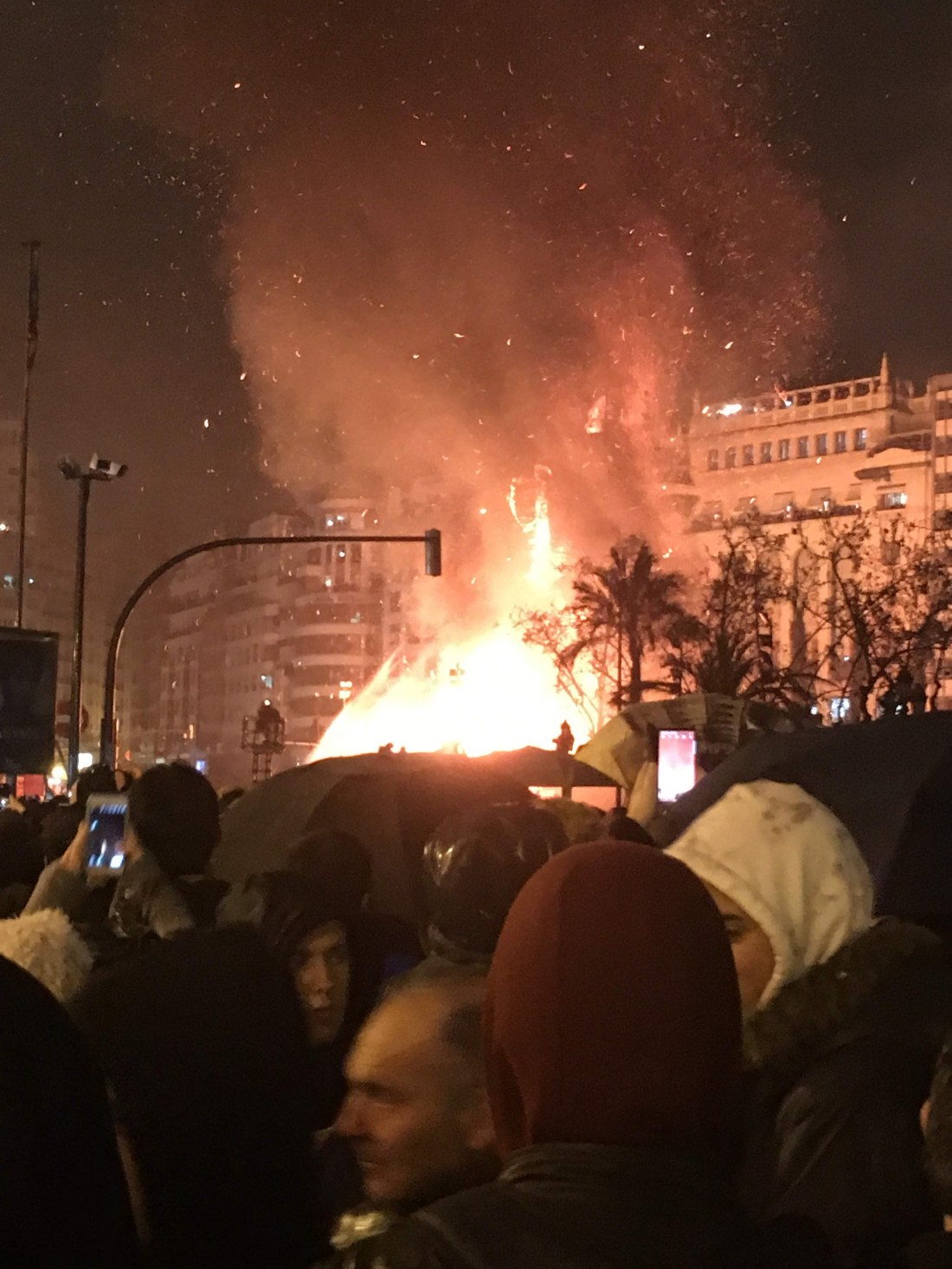
On the last night of Las Fallas, every falla is stuffed with accelerants and burned at regulated intervals: children’s fallas first, then adult fallas, and at 1AM, the biggest falla, the one that occupies the square in front of City Hall. As you can imagine, lots of drinking and eating of buñuelos (fried bread covered in sugar) and general frivolity are involved. It rained like crazy on us for the pictured burning, the 1AM finale, but fortunately as soon as the skies opened the ever-present vendors switched seamlessly from peddling drinks to hawking umbrellas. Despite the deluge, the falla burned right on schedule, and we could feel the heat on our faces as it did.

So where does my Margarita come into all this? It struck me at some point that Las Fallas is a festival of the ephemeral. The music, the flowers, the parades, the fireworks, the fallas themselves – all are intentionally fleeting. Las Fallas has a not so subtle, subversive message: build, but don’t expect your work to last; appreciate, but don’t get attached. The cycles will last – winter will become spring, the parades will return, the fallas will be built – but the objects in these cycles are impermanent. Celebration and destruction frolic together through the streets of Valencia.

And my Margarita knew that the night of the burning of the fallas. The falla in question was in our neighborhood, and the destruction apparently was truly a local event. Onlookers were greeting each other by name, and one woman showed up in her polka dotted bathrobe and pink bedroom slippers. I guess that the falla had been built by a group that had set up tables and chairs and a truly scrumptious-looking spread. The group’s members, who all were wearing matching red fleeces with their names on them, were laughing and drinking and having a grand time. When the time came to burn the falla, though, one girl, maybe about nine years old, appeared in the formal, traditional dress we’d seen in the parades. She was given a switch that was attached to the fuse leading to the falla. She looked at the switch and began to cry. Burying her face in her mother’s dress, she refused to turn around and start the fire. We could see her mother comforting her, no doubt crooning the sorts of words all mothers use: it’s okay, you knew this was going to happen, there will be another falla next year. But the girl sobbed on, apparently suddenly and wrenchingly aware that this moment was passing and would never come again. Next year there would indeed be another falla, but it would be different, her mother would be different, she would be different.

As the little assembly waited patiently for the girl to settle to her inevitable duty, I was reminded of Gerard Manley Hopkins’s masterpiece, “Spring and Fall: To a Young Child.” Many poets tackle the subject of the fleeting nature of life – think of Shelley’s  Ozymandias and the lone and level sands stretching far away – but Hopkins says it best for me. Do you remember his lines?

Márgarét, áre you gríeving
Over Goldengrove unleaving?
Leáves like the things of man, you
With your fresh thoughts care for, can you?
Ah! ás the heart grows older
It will come to such sights colder
By and by, nor spare a sigh
Though worlds of wanwood leafmeal lie;
And yet you wíll weep and know why.
Now no matter, child, the name:
Sórrow’s spríngs áre the same.
Nor mouth had, no nor mind, expressed
What heart heard of, ghost guessed:
It ís the blight man was born for,
It is Margaret you mourn for.

Here, then, was my Margarita, mourning mortality on a street corner somewhere on a Valencian night.

The girl did, of course, as we all do, come to at least temporary terms with her life and her task. After grizzling in her mother’s clothes one last time, she held up the switch and pushed the button. Fire sparked up the fuse, igniting the falla and drawing claps and cheers from the crowd. But despite those outward signs of delight, I wonder if all of us were a bit sobered by what we’d seen. We watched the quick immolation and turned back to our parties or our homes, a little sadder and a little wiser than we’d been. It was, in fact, Margarita that we mourned for.


img_1083


Continue reading “Meeting Margarita”

The Karaoke Kid

Mark has a beautiful singing voice, of which I am the prime beneficiary. Whether it’s “Love Me Tender” or “May the Bird of Paradise Fly Up Your Nose,” he’s on key and on beat with a mellow tone that always melts my heart. A recent round of karaoke on our cruise reminded me that not everyone is similarly talented. In fact, when a friend with whom we were going to karaoke announced that she was leaving at the first flat note, I thought to myself that really there was no point in her sitting down. However, she was a good sport and stayed through some notes with topography that would put pancakes and Kansas to shame, and in fact she did a creditable version of “Back to the USSR.” The only awkward moment in the evening didn’t concern music at all, but instead involved an inebriated Canadian passenger who kept grabbing folks who were leaving and demanding that they stay and have fun. Said Canadian’s spouse sat morosely in a nearby, cruise-gaudy bar, nursing a drink and looking on with a gaze that suggested that this was not the couple’s first karaoke rodeo.

This experience got me contemplating a question vital to the continuation of life on Earth: is it a mistake to sing karaoke when you really can’t sing? The Canadian spouse at the bar aside, we all had fun, even if it wasn’t as long a fun as the inebriated better half wanted us to. What is a mistake, anyway?

My contemplation brought me to the attached picture, which I’d taken some time ago. Presumably the firm marketing the apartments have enough English to know about “secondhand” goods and extrapolated, incorrectly but endearingly, to “newhand.” Intentionally or not, they avoided advertising “firsthand” apartments, which is a good thing, since I probably would still be scratching my head over what a non-firsthand apartment would look like. Maybe that’s when you live in a virtual reality pod that looks like an apartment? Shades of The Matrix movies!

So that was a benign mistake, a concept with which I’m well acquainted. I feel the sign owner’s linguistic pain as I struggle with Spanish. I last studied this tongue formally when Jimmy Carter was president, so most of the verb tenses have long since evaporated or been buried by handy items I learned for the bar exam (the six requirements for a valid indictment in Texas, for example – I use that a lot in daily life) or the words to Barney songs (no doubt I’ll be muttering “I love you, you love me” through my dentures in a nursing home some day). So the other day I completely confused some poor elderly lady when I offered to stand in her place on a crowded bus. “¿Quiero este asiento?” (Do I want this seat?) I asked nicely. What I meant to say, of course, was “¿Quiere este asiento?” (Do you want this seat?) (I’m sure I’ve made a mistake in punctuation here, but tough.) She gave me a look not unlike the one I gave the drunk Canadian on the ship and edged away a little. Poor lady.

So that was an odd but inadvertent mistake. Other linguistic transgressions are more intentional. For example, Spanish nouns have the audacity to have genders. So you can’t just skate by with an all-encompassing “the” as your definite article. Oh, no, you have to choose between “la” for a feminine noun and “el” for a male one. And don’t ask me what you have to do to adjectives in terms of gender, because it makes me cry. So in an effort to simplify my life and strike a blow against the patriarchy, I’ve decided that all of my nouns are feminine, except on Sunday, when out of Christian charity I make them all masculine to even things up a little. I’m therefore wrong about 50% of the time, but I’m never uncertain. Hey, it works for Sarah Sanders!

True confession (Is it a confession if it’s not true? Thought for another blog post): I make intentional mistakes all the time. For example, our church back home performs a sing-along “Hallelujah Chorus ” at Easter. I sing along, picking the part that I like most which is currently being sung. That way I always get the best lines. You’ve heard of a one-man band? I’m a one-woman chorale and proud of it.

And then there are mistakes that are born from deep confusion. Here my prime example is the two Spanish verbs for “to be.” On some level, it’s philosophically enchanting that “ser” denotes a permanent condition – Yo soy un humano – and “estar” is for temporary conditions – Yo estoy feliz, but I might not be tomorrow. But using estar for locations makes zero sense to me. I get that my location is not permanent; after all, we just moved to another continent. But unless you’re thinking in terms of continental drift, many locations are darn permanent. New York is on the Atlantic (unless we’re talking about global warming, in which case New York is at the same latitude and longitude but could be under the Atlantic). And even after Gondwana reforms itself and you can walk from San Francisco to Delhi without getting your feet wet, Amarillo is still going to be in the middle of nowhere. And does the concept of what’s permanent change? Google translates “I am blonde” as “Soy rubia,” but we all know several blondes who are a couple of missed hair appointments away from mousy brown. So there’s that.

In any event, whether intentional or not, mistakes are going to happen. On good days, making mistakes is like jamming in music; you make a mistake and you get a new song. On bad days, it’s more like losing a game of Battleship: you had way too many misses and no hits to speak of. And then there are the great days, when you start to make a ho-hum, new glue and end up with Post-its. The important point is that you own your mistakes, learn from them, and make them part of who you are. That way, I suppose, they’re newhand. And that shall be a sign unto you.


Palm Friday

This title is completely, intentionally confusing. If you’re Christian or are familiar with Christianity, you know that we celebrate Palm Sunday, not Friday, and that’s done a week before Easter, not at the beginning of the Lenten liturgical season, which is where we are now. If you’re not conversant with the Christian calendar, you may be wondering what palms and Fridays have to do with each other. The key to clearing up the confusion is that we just got back from an amazing 11-day cruise which included a Friday stop on Las Palmas on Gran Canaria. In case this puts you in mind of a giant Tweety bird, as it does me, just know that GC is the biggest of the Canary Islands, and a lovelier spot would be hard to find. And the Romans named the islands after the dogs they found there, not the birds. Just FYI.

Our wonderful cruise started in Barcelona and went to Casablanca (we saw the ersatz Rick’s Cafe Americain but didn’t go in), three of the Canary Islands, Madeira, Málaga, and Alicante. Each of the stops was fascinating and lovely in its own way. For example, Lanzarote (another Canary Island) has, depending on how you look at it, the curse or blessing of otherworldly volcanic landscapes and prickly desert vegetation. People have lived in this difficult environment for hundreds of years and have adapted to it in truly creative ways. My favorite adaptation was a bar set in a lava tube, adorned with ferns and overlooking a clear pool of water filled with tiny, white, blind crustaceans. On the other hand, you have relatively lush vegetation on Madeira, a Portuguese island with beautiful verdant parks and so many colorful  bird of paradise flowers just past prime that Mark and I made a game of finding the ones with withering plumes and trying to figure out which was having the worst hair day. So variety was easy to come by.

What often isn’t easy to come by when you’re traveling, though, is companionship beyond the travelers in your party. On previous cruises, we’ve made acquaintances but no real friends. On this one, though, we met two lovely women from Canada and, randomly, four other folks from Austin. The eight of us (Lynne, Laura, Sherry, Liz, Janice, and Mack, to be specific), really hit it off. We ended up in various combinations eating together, playing shipboard trivia – emu eggs are green, just so you know – touring exciting new places, and just hanging out watching shows or listening to a creditable homage to Santana in the ship’s pub. The picture accompanying this post shows all of us but Lynne and Laura hooking our horns in front of the Lone Star Bar in Santa Cruz on March 2, Texas Independence Day. (All persons in this photo consented to its being posted with my blog. However, they consented at the time of its taking and may not remember that! Let me know if there’s a problem.) The hook ‘em sign is probably obscene in several of the places we just visited, but we made sure to snap this early in the morning and when no police were in sight.

Now, don’t get me wrong: Mark’s a great traveling companion, and we had many fabulous times just the two of us on this cruise. We took merengue and salsa dance lessons, and we danced into the night to music from the Beatles, ABBA, and the like as rendered by a surprisingly good Filipino band. Admittedly, dancing when the sea is rough occasionally requires terpsichorean innovation. “She loves you, yea (lean left with the ship), yea (lean right with the ship), yea (lean left again with the ship) can be challenging, to say the least. But you should see us on the floor! Or, on reflection, perhaps you shouldn’t. That could be a mental image you don’t need.

Anyway, seeing lots of palms and visiting Las Palmas on a Friday got me thinking about the word palm. You can palm things off or palm a card like the magician on our ship undoubtedly did. You can cross someone’s palm with silver, or in our case, Euros. But what I’ve been contemplating is the palms of my hands. Palms, for all of their visibility, are actually quite intimate parts of the body. You hold small treasures, like seashells or birds’ eggs or precious jewels, there. You cradle your lover’s face and your infant’s head there. You rest your chin there while puzzling over one of the world’s many mysteries. And a kiss in the palm can be incredibly romantic when bestowed by the right party. I’d never really thought about palms before, but they are fairly amazing.

Palms have their limitations, however, and it seems to me that the biggest one is that they can’t actually touch each other. It’s true! Press your hands together as tightly as possible. The very centers of these intimate parts of your body are separated by a tiny space, a little pocket of air that just won’t quite go away. (Maybe it’s space for the Holy Spirit, like kids at church dances were supposed to keep between them. That went well, didn’t it?) If you want the centers of those palm centers of your being to be touched simultaneously, you need someone else.

I think that the reason our cruise was so great, then, even beyond the lovely destinations and pitching dancing and never-ending supplies of food, was the company of our new friends. They touched us someplace deep. They enriched our experience and gave us both fresh perspectives and respite from sensory overload.  Traveling never ceases to amaze and challenge us. Friends amaze and challenge and renew us. Our palms were opened to the touch of our pals onboard, and, oh, how much the better off we are for it! I’m grateful from the bottom of my heart – or perhaps from the centers of my palms – for these people and this experience. img_1164

From a distance

Do you remember “From a Distance,” a song Bette Midler made popular several years ago? A bit of its theology gave me pause – the God I know doesn’t watch from a distance – but it was a nice song overall and made some good points about viewing people from different vantages. The lines about far-away enemies looking like friends and the Earth appearing peaceful give a nice sense of the perspective of distance. But lately I’ve been thinking about a different issue, namely, perspective on distance.

This line of thought began with news of a ship. (I know – first it was food, and now it’s the maritime trade.) This particular ship matters a lot to Mark and me, because somewhere in the bowels of the Brevik Bridge is a cargo container with 29 boxes of our stuff. Yes, 29 is an odd number, literally and figuratively; heck, it’s even a prime number, and I dislike prime numbers on the grounds that they are unfriendly and do not play well with the other digits. But, alas, when the packing dust settled, we’d filled 29 boxes, and it’s sufficiently expensive per box that I just didn’t have the heart to tack on one more to round things out. So when we got an email this week telling us that the BB was leaving Charleston with our prime number of boxes, it was great news.

It turns out that even more fun lay ahead. Mark discovered a cool website where you can track ships. So we cheered when the Brevik Bridge sailed out of Charleston harbor and groaned when it had to wait to load in Savannah. Today’s update tells us that our ship is headed out into the ocean. Next stop, Le Havre! At the risk of sounding like someone who watches the Weather Channel all day, tracking the relatively slow progress of my carefully-packed Cutco knives and my beloved T-shirt quilt is remarkably entertaining.

Looking at the map to see the ship’s progress has gotten me to thinking about my perspective on distance. The ship seems far, far away. Our stuff seems far, far away. But interestingly, our families and friends in the US don’t seem so far away at all. Facebook, email, FaceTime, and cell phones keep us in pretty good contact. I send birthday wishes, hear about friends’ kids’ school plays and gymnastics meets, have nice chats with our kids and my sister, and keep up with what my book group is reading. Sure, I can’t go out to lunch with my buddies or get grand hugs from my friends at church, but Mark and I both feel like we’re keeping up with you all, which is wonderful. Please reach out to us if you want to be in contact!

Similarly, and probably more weirdly, we feel here the same lack of power to affect forces shaping our lives. Skipping merrily over politics, because it’s too early to start drinking, I’d lift up as an example the called General Conference of the United Methodist Church. Here comes a little religious inside baseball, but it’s much on my heart this week. This conference most likely will determine whether our denomination, if it survives as a denomination, will end its shameful treatment of LGBTQ persons. Mark and I both love our church and grieve its despicable stance and actions on this issue, but besides praying, we can do nothing to affect the conference’s outcome. But the same would be true if we were in the US, although if we were there we could be hanging out with our friends who are in the same boat – or in this case, I guess, on the same ship.

Now, on some level I’ve already known that how distant you feel is more of a perception than an objective reality. Being a mom is a case in point. Because our home in the States is in Texas and both our daughters and our son-in-law live in the Midwest, we’ve relied for a long time on technology and airplanes to stay in touch. So do I miss the kids more because we’re physically farther away? Not really. But do I miss the kids? Of course I do, so much that it hurts sometimes. But of course that process of detaching from them starts, literally, the day they’re born. As soon as they

pexels-photo-164957.jpeg
Photo by Pixabay on Pexels.com

slip out from between your legs, they are separating from you. Sure, I got to hold my precious girls right after they were born, but then they get whisked off to a nursery to do God knows what. It’s started – they’re in a different room. That becomes a different building, then a different state, and, now, a different country. Do I miss them? No, because they are amazing, functional adults. Yes, because they are flesh of my flesh and bone of my bone, and part of me is gone forever.

So there’s distance and there’s DISTANCE, and on some level it’s all a matter of perspective. And of practicality – our kids are great, the Methodists will do what they will do, and pretty soon Facebook will be filled with pictures of Austin sunsets and what everyone is having for dinner. And before long I will be typing other blog entries on my tablet while snuggled under my T-shirt quilt while the dishwasher chugs away cleaning the Cutco. And to that, let the people and Bette Midler say amen.