Ah, sea – ah, sea

This title is a pun. “Asi, asi” is Spanish for “so-so.” But life is anything but just so-so! We are back in Torrevieja after two months in the USA. Our time there was lovely, with many travels, many friends, and many baseball games. And then there’s the Tex-Mex and barbecue….I need to walk more now that we are away from those temptations. 😉

Mark and I arrived in Torrevieja early on Thursday morning and slept till noon the next day. We’ve been unpacking and stocking groceries, toiletries, and the like since then. As our apartment was rented out while we were gone, things are in some mysterious places around here. And over those months we lost a dozen or so of our best clothespins but gained a green bathmat and a pen shaped like a small, silver fish. Would you call that even?

Life outside our apartment is good, too. The weather is warmer and more humid here than we’re used to, but outdoor life goes on. We had tapas last night with friends and ate at a table outside the restaurant, and today after church we had coffee with friends in the congregation under a nice umbrella at a local cafe. Mark and I are walking and swimming a lot. He’s particularly happy with regard to the latter activity, particularly because here he doesn’t have to vacuum the swimming pool. The Mediterranean is lovely and just the right temperature now for swimming, floating, and generally hanging out in the water.

Besides the weather, the biggest change here is the number of people in Torrevieja. The beaches are packed. Restaurants are full. Red shoulders that are painful just to look at abound.  And there’s a fun fair across the street from us that stays open till 2AM. Soundproof windows deal with the potential nighttime noise issue, and the lighted rides at night are a sight to behold. And best of all, our daughter Jane and her husband J.J. arrive tonight for their first visit to Torrevieja. Hooray! If experience is any indicator, look for us on the rides at the fun fair img_0080tomorrow night.

Hut two three four

The picture and the title are a little obscure this time, but I promise an explanation is coming.

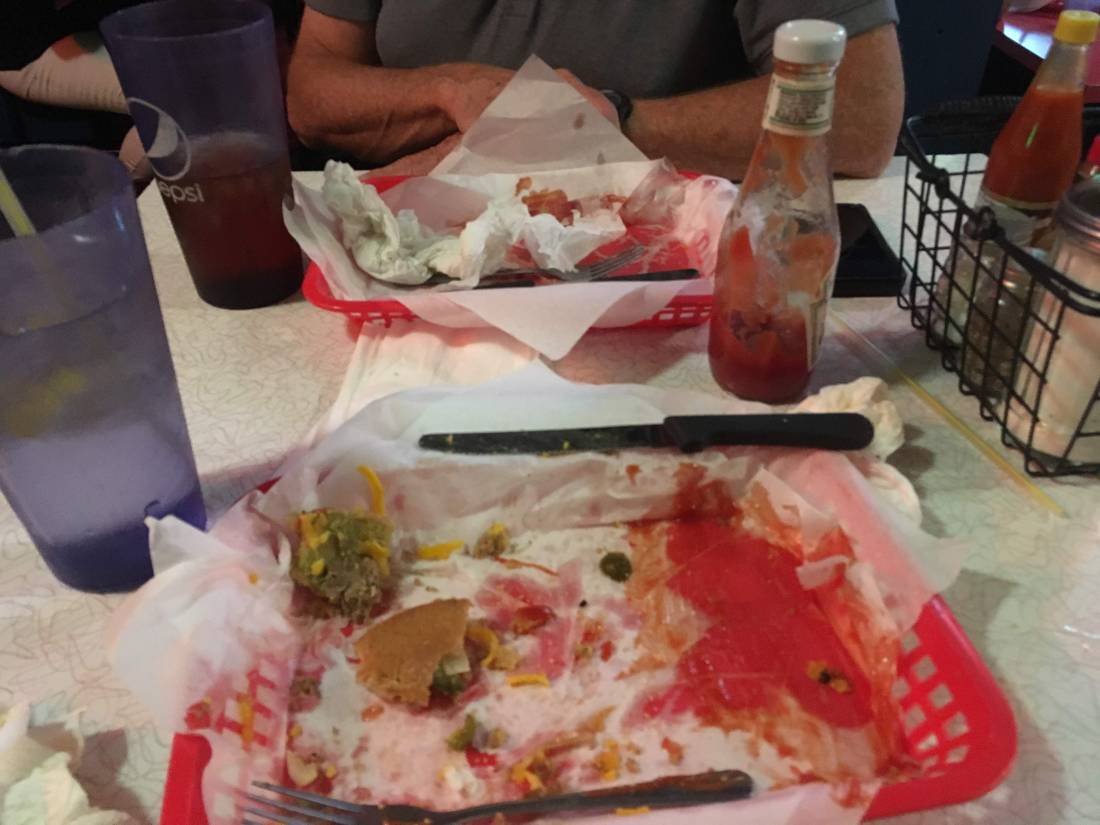
The picture dates to the first weekend we were back home in Austin. After attending a service at our beloved First United Methodist, Mark and I headed to our favorite burger place, Hut’s Hamburgers. For years, we’ve ordered the same thing: a Richie Valens meat and a half order of fries for him, and a Richie Valens veggie and half order of onion rings for me. As you can see, we enjoyed our repast. It was a bittersweet meal in some ways, though, because Hut’s is closing its doors in October. Hut’s opened in 1939 and moved to downtown Austin in 1969, so this is a big deal.

So as Mark and I change by dint of our European adventure, Austin changes as well. I swear the traffic is worse than it was six months ago when we left for Spain. That’s bad. Bee Caves Road has a left turn lane onto Westlake Drive now. That’s good. Oh, and new people are sitting in our usual pew at First Methodist. But the Lord will forgive them, for they know not what they do. But mostly it’s lovely to be here, and that’s mostly because we are seeing scads of family and friends. And generally we’re seeing them at mealtime. We’ve eaten lots of Tex-Mex and barbecue in very good company.

What is it about breaking bread – or tortillas- with someone that cements a relationship? I suppose it’s partly because everyone, however lowly or lofty, has to eat. Eating here also reinforces our cultural ties – hence, the Tex-Mex and barbecue. Writing about this idea brings to mind the story a friend told me after reading an earlier post involving my desire for American peanut butter. She told me with a laugh that when she was traveling frequently to Germany for business, expat pals would ask her to bring along foods from the US that they craved. She said she felt like a peanut butter and Cheerios mule, which is an image that still makes me smile.

But besides reinforcing our common humanity and culture, eating also is a tangible, gentle reminder of how little in our lives lasts. I guess that’s why Ecclesiastes and Isaiah both command us to “eat, drink, and be merry.” Wise people who knew mortality up close and personal wrote these books; in fact, Isaiah finishes his commandment to prandial pursuits and jollity with “for tomorrow you may die.” Presumably he was always the life of the prophetic party.

So what’s the best meal we’ve shared while in Austin? At the risk of sounding super corny, it was Communion at church the second Sunday we were home. No tacos were involved, so it’s a close call to pick this as the best, but we were lucky enough to be asked to help serve. After six months away, we were sharing a meal with all of the people who came through our line. Not everyone was familiar; probably not everyone was even a churched person, because our denomination practices open table and offers Communion to anyone seeking God in his or her life, in whatever form that quest may take.

And so we went. Mark held the cup, and I preceded him and tore off the bread and placed it into the cupped hands each person presented to me. I can’t say I did a great job tearing the bread; some pieces were minuscule, and others were so large I found myself hoping that the curriculum in seminary included administering the Heimlich Maneuver. But no one choked up, except for me, when I got to lightly grasp each person’s fingers, press bread into the waiting palms, and look into welcoming eyes. This is humanity and culture and mortality and transcendence, all in one bit of King’s Hawaiian (gluten free available at the north station). Best meal of the trip, for sure. Maybe the best meal ever.

I’ll close by leaving you with what we all said together after Communion. It’s way better than anything I’ll ever write.


Prayer After Receiving 

In gratitude, in deep gratitude

   for this moment, this meal, these people,

   we give ourselves to you.

Send us out to live as changed people

   because we have shared the Living Bread

   and cannot remain the same.

Ask much of us,

   expect much from us,

   enable much by us,

   encourage many through us.

So, Lord, may we live to your glory,

   both as inhabitants of earth

   and citizens of the commonwealth of heaven.

Amen.


img_1509

The long and whining road

lnd_651d2237-810b-4d82-97bc-ef9a89c7ddda-1The title is with apologies to the Beatles. While our trip in the US thus far has mostly been lovely, we’ve had a few bumps along the way. Just to make sure that I haven’t fallen into the trap of making our lives sound perfect, this post will basically function as the blooper reel for our travels.

Blooper one actually occurred in Austin, even though we haven’t gotten there yet. We carried two large bags across the ocean, one of which was filled with items we were taking back to Texas. While visiting Jane and JJ in Cleveland, one of us (apparently we’re both prone to taking the blame, so we can’t agree who) had the bright idea of shipping the Texas suitcase to friends in Austin. The shipping fee was less than the bag fees for hauling it on our road trip, and we’d have to do less schlepping. The theory was pretty good, but the execution left a lot to be desired. In short, UPS claims that the suitcase was delivered, but it never arrived at our friends’ place. Gone, I take it, are the dress I wore to Jane and JJ’s wedding, one of Mark’s suits, our best laptop, a pie knife I’d bought at a Paris flea market that matches our flatware, an embroidered table runner from Madeira, two rocks from a Mediterranean beach brought for a friend who collects rocks from different places, and other items. I’m trying to think of it as involuntary decluttering.

Then there’s the saga of the hotel in, I think, South Dakota. We arrived late at our hotel, where it was obviously amateur night at the front desk. As you can see from the key folder pictured here, we didn’t end up in the first room to which we were assigned. That room’s electronic lock wouldn’t unlock, despite new batteries and lots of fiddling around by a well-intentioned but truly puzzled IT guy. The hotel then assigned us to room 417. Hallelujah – except there was a startled guy in red boxers already in there. Thank God for the boxers is all I can say. We slogged back to the front desk and informed them that the current occupant was disinclined to share. The woman at the front desk the reassigned us to yet another room, which I’m happy to say the IT guy checked before we hauled our bags around again. It, too, was already occupied. Finally, by the grace of God, sheer luck, or whatever other force you may wish to ascribe this occurrence to, we were assigned to a room that actually had no one else in it. After a little negotiating, which started with an offer from the hotel of a free bottle of water, we ended up staying for free that night.

And then there are the highways that run in directions that only a character from Joseph Heller’s Catch-22 could love. At one point in our ramblings we drove on North IH 35 West. That probably makes sense to somebody, but not to me. And we drove 45 minutes out of Fargo towards Minnesota and then stopped for gas. The signage doing what could loosely be termed “guiding” us back onto the highway was so bad that we ended up back in Fargo. No wonder Facebook keeps showing articles about how Google maps directs people into fields in the middle of nowhere. Nowhere appears to be everywhere!

In fairness, I’m fully aware that our problems are minute in comparison to those endured by many. The kids in the #TrumpCamps, for example, would be thrilled to have their accommodations be as good as ours and our journey as smooth as ours. And as for the suitcase, it’s just stuff. Some of it was stuff we care about, but it’s still just stuff. We’ve seen our amazing kids, seen a lot of fun baseball, hung out with dear friends, and visited the last of our 50 states. (N.B. The award for the most random national monument goes to Mount Rushmore. Who looks at a mountain range and says, “I think I’ll carve the heads of presidents on that”?) So perhaps I should switch from the Beatles to Sheryl Crow. Every day is a winding road, indeed. And tomorrow we wind to Austin! Here’s hoping we have no addenda to this post.


Nifty fifty

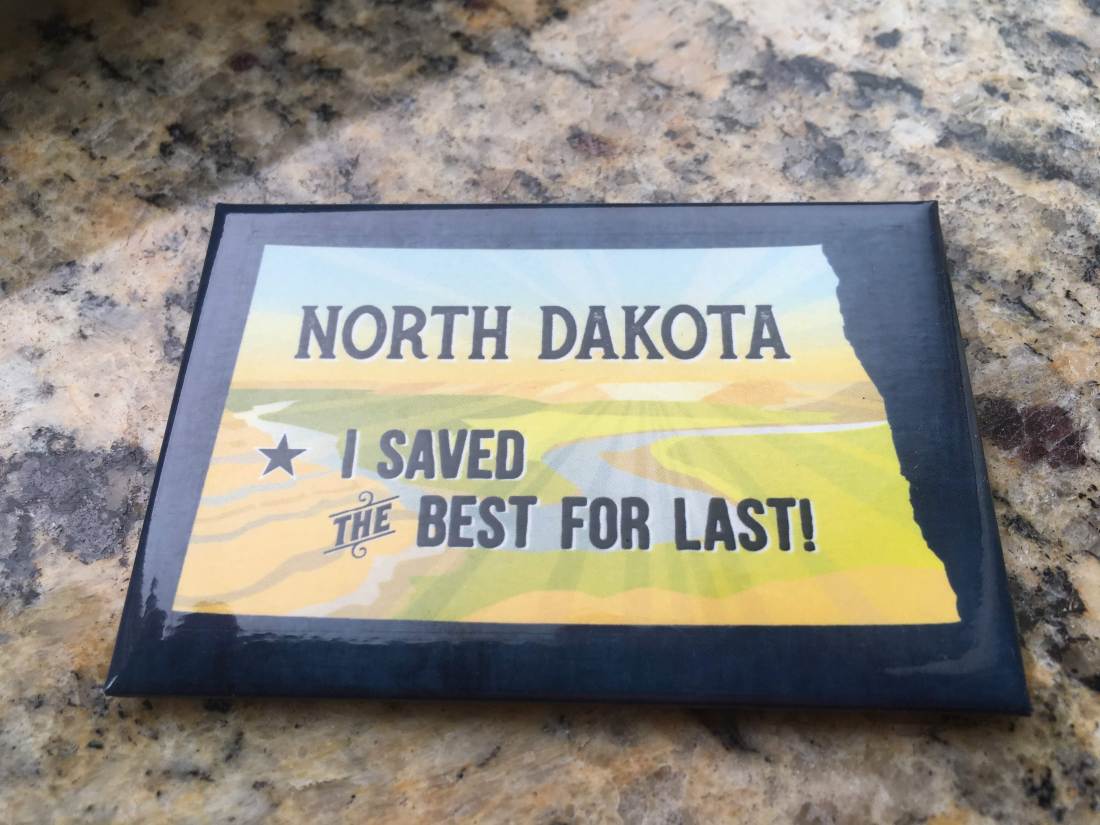
Mark and I rolled into North Dakota yesterday, thus now having visited all 50 states. We’ve seen 48 of them together and have agreed that our having seen Mississippi and Georgia separately is going to have to suffice. We’re not going back to either, along with a few others I could name. One Facebook buddy told me that he thought we ought to get a patch or something for our accomplishment. I agree, although it’d be even nicer if the prize were a percentage point off the top marginal rate on your income tax, or at least a BOGO coupon to Pizza Hut. At least we got the refrigerator magnet pictured here. You’ve gotta give North Dakota credit for a sense of humor.

We’ve picked up our last states on the longest road trip we’ve ever taken with each other. We started in Minneapolis and have hit Iowa, Nebraska, South Dakota, and North Dakota since then. It’s a long time in the car, but we’ve listened to some fun audiobooks (the Janet Evanovich Fox and O’Hare series, which careens between elaborate con schemes and gigantic explosions), talked a lot (we’ve covered, inter alia, the meaning of baptism, climate change, our differing views on how empty the gas tank is before it’s time to refill, and why the Astros just dropped three straight games to the Reds). We also are okay both with silence and with the other person gasping at close calls in your driving. Mark does a disproportionate amount of the driving, so I do a disproportionate amount of the gasping.

Gasping aside, this is not even close to the worst trip that we’ve had while seeking out a new state. That dubious honor goes to our jaunt to Idaho. In 2009, we took Mary and a friend to Yellowstone. The park was fabulous, and we added Montana and Wyoming to our list. Because we were pretty close to Idaho and unlikely to be in the vicinity again any time soon, we decided on a quick drive to Idaho. So we packed up the kids and headed west. Sure enough, we crossed the state line and were rewarded with views of lush meadows and small blue lakes. Because our rule on state visits is that it doesn’t count if you simply drive through or never leave the airport, we decided to stop at the only convenience store we came upon. We parked and noticed that this shabby, no brand building was adjacent to a big, silver, new Airstream trailer that was surrounded by a padlocked chain link fence and had Dobermans barking in every window. Even more surprisingly, when we entered the store, we realized that the entire building contained approximately two dozen items for sale, comprising mostly Cokes and beer in a freezer case, two dusty bags of Cheetos, and three gallon containers of bleach that could have stood a good bleaching themselves. Having read a lot of murder mysteries, I suddenly realized what was going on. We’d taken two adorable teenage blondes, one of whom wasn’t even ours, into a meth lab. Crap. I grabbed two Cokes and the Cheetos and pulled out a wad of bills with which to pay the rail-thin guy with greasy hair and suspicious eyes who stood at the register. “Gosh,” I chirped, channeling Beaver Cleaver’s mother for all I was worth. “We’re from far, far away, and I have no idea where we are! And now we’re leaving Idaho after a stop at your fine store!” I think he thought I was stoned, too, so he just handed me some change. We hightailed it back to the Park.

Most of our state visits have been far less eventful. We’ve seen gorgeous scenery, including the aforesaid Yellowstone National Park, glaciers in Alaska, the Maine and Oregon coastlines, the Grand Canyon, a live volcano in Hawaii, Big Bend, and, just now, the prairies and the Badlands. We have marveled at spectacular structures such as Monticello, the US Capitol, and the cliff dwellings and pueblos of the Southwest. We’ve met some great people, too, like the widow in Grundy Corners, Iowa, where we stopped for malts at a local drugstore. She opened a friendly conversation by asking where we were from, and we fell to talking about traveling (Florida was her favorite), how she and her late husband used to ride bikes for exercise, and how her father-in-law embarrassed her by telling a waitress to “put a little cow” in his coffee. I don’t actually understand why this comment was so embarrassing, but this happened in 1992, and she’s still mortified. Or there was the dad in the hotel where entrants in a baseball tournament were staying. Dad and son stood together in the elevator. The boy, who was maybe eight, was in a baseball uniform that had seen some recent and fairly substantial slides and showed a face that’s that odd kid face that combines anger and a deep desire to cry. Wisely, Dad wasn’t talking to his son, but he did rest a gentle, reassuring hand on a sad loser’s shoulder. Or the mother on the tram, hardly more than a kid herself, alternating peekaboo and assurances of love with the tired, squirming toddler whom she was holding. Yes, there are some pretty great things in the USA.

But it’s not honest to say that all is well in our country. We may be the home of great milkshakes, but we’re also the birthplace and continuing home of the KKK. A pimply fellow in a grungy video game T-shirt at an overlook in one of the parks we just visited felt the need to have a handgun strapped to his belt. Rural areas may be scenic, but if you look at the houses en route you’ll notice peeling paint and rotted roofing and porches that list to port under the weight of dirty loveseats. The houses’ occupants sit out on the porch during the day because they don’t have jobs to go to and at night because there’s no AC or money to run one if they had one. And in an alarming number of fast food restaurants, tiny grocery stores, and gas stations, young kids are tucked away with iPads and sodas, spending much of their summers with a parent or grandparent who can’t afford to miss work or pay for childcare, much less a summer camp like the one our kids loved, full of busy days of swimming, riding horses, and buying ice cream treats at the camp store.

Perhaps the contradictions of contemporary America can best be encapsulated in the baseball game we attended last night. We drove to Dickinson, North Dakota, to see the Badlands Big Sticks (Mark has asked me not to repeat the ribald jokes I made about the team’s name, so use your imagination) play the Freemont Moo. Seriously. The mascot for the Big Sticks is a felt version of Theodore Roosevelt; he appears on the T-shirt I bought, the acquisition of which was my main motivation for attending the game. The Moo did not bring their mascot, which presumably is a cow. But I went to the University of Texas, where Bevo, the Longhorns’ mascot, is as ubiquitous as traffic jams in Austin, so the cow’s absence was no great loss to me.

But here was America in all its glory, right? College players from as far away as California and Florida had come to the Plains to play that quintessentially American game and perhaps get an edge that would make them college stars and, for a lucky few,  players in the Major Leagues. Blonde kids, Latino kids, African-American kids, whatever kids were out on the field, making a few spectacular hits and catches and quite a few more spectacular non-hits and non-catches. The local Bank and Trust sponsored the stadium, and the Ford dealership, according to the announcer, sponsored the pitching changes. I still haven’t figured out how anybody but the pitching coach sponsors pitching changes, so please don’t ask me to explain that part.

The crowd looked to be mostly local folks, including the giggly teens behind us and the girl two rows ahead of us who was proudly wrapped in her “State Golf Champions – Girls Division B” jacket. All of the teenagers, of course, were on their phones for most of the game. Families were everywhere, which is both heartening and heartbreaking. Mothers juggled more children than they really could look after, barking orders at older kids, sticking pacifiers in the mouths of anyone too young to be yelled at, and growing more frazzled by the minute. Guys looked to be farmers, mostly, and they drank more beers than anybody driving probably should and worried aloud about recent rains flooding out their crops and wondering why severe weather seemed so much more frequent over the last few years.

The home team won, and all of us American contradictions wrapped our jackets a little tighter around ourselves as we walked from the park. Are we a good nation? Are we a troubled nation? Are we both? I still don’t have answers, even after seeing all 50 states. Nevertheless, I’m proud and excited that Mark and I have achieved this goal.


img_1455

Whose body?

img_1585Whose Body? is the name of a Lord Peter Wimsey mystery and therefore by definition one of my favorite books. Interestingly, our current jaunt in the USA has raised this question in a number of ways.
Before we get to the bodies, let me explain where we are in said jaunt. We flew from Madrid to New York on June 5-6. The flight was fine, especially since we were in business class on Norwegian. New York’s not my favorite city, even for an overnight stop; if I got to choose, I’d keep Broadway, the Strand Bookstore, a couple of museums and historic landmarks, and a bagel shop. The rest I’d treat as I used to threaten the kids: package it up and mail it to Australia without a return address. But I’m not sure either if UPS would cooperate or the Australians deserve the Yankees. So NYC is safe for the time being.

Suffice it to say that I was especially glad to reach Cleveland the next day. Mostly, of course, this was because we got to see our dear kids, Jane and JJ. We had scrumptious pizza with Jane the night we arrived. The next evening we were privileged to attend the graduation ceremony marking Jane’s completion of her residency. Trigger warning for parental bragging here: Jane received the most awards in her oby/gyn residency class and was praised to the skies by the doctors who’d worked with her. We sat with several of those doctors during dinner, and when they weren’t talking about Jane they pretty much were talking about women’s bodies. This makes sense, of course, at a table including several oby/gyns.

I’d say that much of the discussion was Greek to me, although one suspects it was in fact Latin. But I did understand the most of the discussion of access to contraception – more accurately, the lack thereof. We all know that I think information about and access to contraception is critical, so we won’t belabor (small pun) that issue. Instead, the discussion struck me as focused exclusively on women’s bodies, so I asked Jane later if contraceptives for men, other than condoms, were available. She told me that to her knowledge not much activity in that field was taking place; in fact, a 2016 study on a male hormonal contraceptive was dropped after participants complained of side effects including mood swings and acne. Insert eye roll here. Granted, a couple of the guys in the study had deep mood swings, but after 30+ fertile years I’d see your mood swings and raise you seven pimples. Duh. In all fairness, research is ongoing, but the vast majority of the burden will be laid on women’s bodies rather than men’s for the foreseeable future.

I’ve also been thinking about women’s bodies just by dint of the traveling process. A couple of years ago, I realized in an airport that while walking in concourses, I’d pull in my arms and shoulders to let men pass. The men involved seemed uninterested in or oblivious to the possibility that they might pull in for me. That galvanizing moment, I decided that I wasn’t tucking in for guys any more (exceptions are made for the infirm). Since then, I have had lots of bruised upper arms and dirty looks from guys who glare at me for not getting the memo that it was my duty to get smaller so that they could walk around being unimpededly big. In my head, I’m saying “No tuck, you f***,” which makes the bruised arms worth it. I don’t care about the glares.

So that’s armed combat. The other part of traveling involving women’s bodies is – wait for it – all the women in the audience say it together- MAN SPREADING. The following example took place at a ballpark, not on a plane, but you get the idea. Mark, JJ, and I went to an Indians/Yankees game. The Indians won, which made the evening extra lovely. But after we had taken our seats, a man and a woman sat down  next to me. Apparently reliving his glory days at the plate, the guy immediately adopts a batting stance in his seat. His leg is therefore trying to take about half of my leg space. My leg guards second base and refuses to move. He gives me a dirty look, and I respond with my best blank face (think a Parisian when someone says “Howdy, ban joor, and ooh-la-la!”). He nudges his wife, and they actually move down a row! Mark and I share an eye roll at that strategic retreat and repeat the process when the rightful owners of those seats evicted the offended couple. They return to their original seats, but this time she sits next to me. Wow. Honestly, if your crown jewels require extra leg room, put your money where your penis is and buy a two seats in coach or one first class throne. The following example didn’t take place at an airport, but you get the idea.

So I’m very aware right now in our travels of women’s bodies, my body, and the ownership thereof. But lest you think I can’t stand to be touched, I’ll leave you with an encounter that took place on Tuesday. Mark and I were waiting for a tram to ride to a Twins game, and we were about the only folks on the platform. A guy with a blindingly yellow T-shirt and sunglasses lenses to match and, in that Minnesota party city, loads of Mardi Gras beads, yells at me (in a friendly voice), “Hey, Girl!” Trust me, that was an upper case G. He rambles over, high on life and perhaps a few other things, and chats at us. Riley – he introduced himself three times, so I’m clear on the name – told us about his mother, his recent release from prison, someone’s car wreck on the way to bingo, and the fact that he’s 49 years old. We nodded and murmured a lot. As our tram approached, Riley declared that we were angels and gave me a sweet kiss on the cheek before ambling off to find any other celestial beings who might be headed to see Martín Perez pitch. And I didn’t mind one bit, not even a little.


The answer is yes.

The question, in case you are interested, is “Are we coming or going?”.

Tomorrow Mark and I take a midday train to Madrid and then connect to the airport. In the evening, we board a Norwegian flight to New York. We spend a night there and then fly to Cleveland to see our beloved Jane and JJ. During that visit, we get to celebrate the close of Jane’s four-year residency and upcoming job as an attending physician at a hospital in Cincinnati. Then we head off to pick up the five states we haven’t yet seen and, in the process, visit with our precious daughter Mary, who’s working at her first law job this summer at the City Attorney’s Office in South Bend. Baseball will be involved, I’m advised.

From there we fly west to visit our dear friends the Aldaves in Oregon and, we hope, see my college buddy Brett in Portland. From there we swing down to Austin for July and spend the month seeing friends and family and taking care of business before we return to Spain in August. Whew! We have two weeks here in Torrevieja before heading off on a cruise to the Baltics, Scandinavia, St. Petersburg, and various Northern European ports. We land in Southampton and indulge my Jane Austen cravings in Bath before heading back to Spain for the fall.

We have many miles ahead of us over the next few months. And we won’t love every minute of it, because some of traveling is always frustrating, tiring, or both. But will we love the vast majority of it, because we get to see new places and dear, familiar people? Really, need you ask? The answer is yes. img_0569


Feeling a little salty

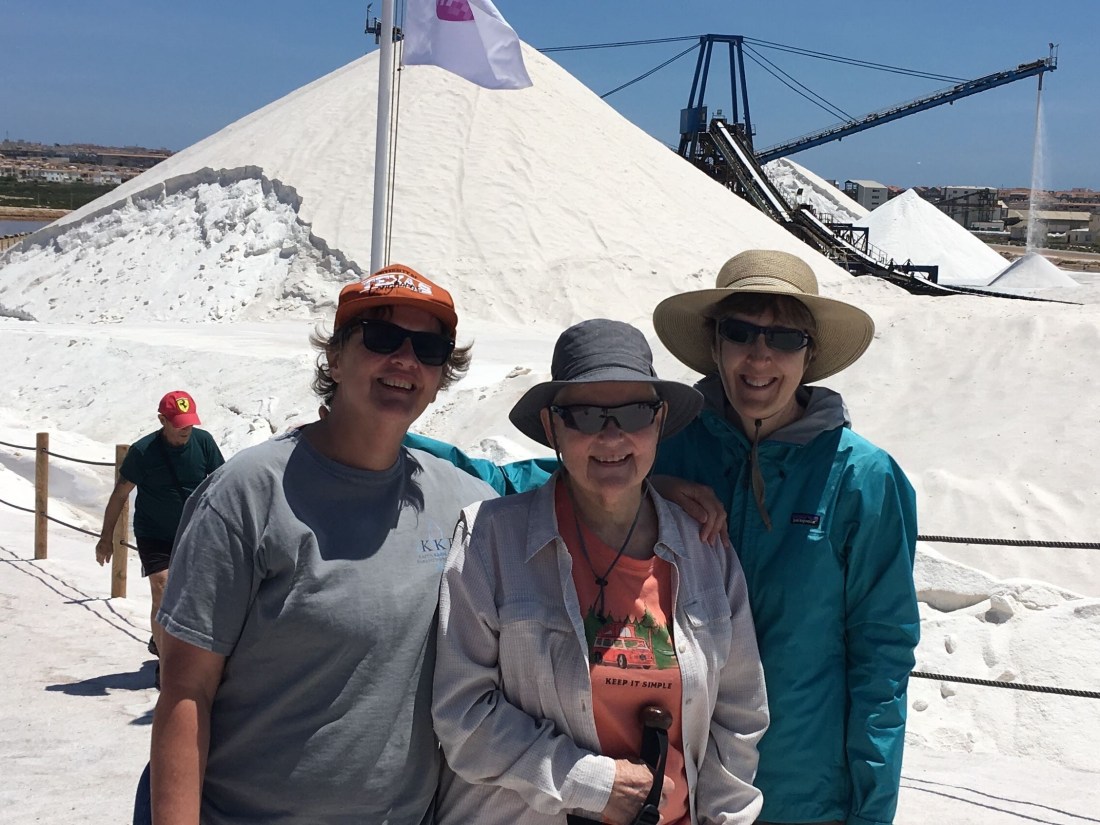
I’ve mentioned before that Torrevieja is known in part for its salt works. People have been harvesting salt from the sea in this area since pre-Roman times. This week, Mark and I took two dear friends whom we’ve know not quite as long as the salt works have existed here to see our local industry at work. The picture attached shows Annette Jones, Susan Spruce, and me standing on a hill of salt. Loading operations appear in the background.

The way you get into the salt harvesting area is actually a bit cheesy. You ride in a tram that has been spiffed up to look like a train that would have made regular stops at Captain Kangaroo’s Treasure House. For those of you who missed the joys of mornings with the Captain and Mr. Greenjeans, think trams from the Disney parking lots, except a lot smaller and with substantially lower production values. We’ve taken this train tour twice, and both times I’ve half expected a cartoon character or large puppet to drive us. Alas, both times it’s been guys with blue company polos, tennis shoes, and, judging by the aroma that wafts by when you’re seated in the coach and they come by for your tickets, a two pack a day cigarette habit.

But while riding in this train seems a little goofy (people who appear to be perfectly normal do wave to you from the sidewalks, and not all of them are wearing shirts with “Frozen” characters on them), the salt works are all business. Locked inside a security gate is a compound including lots of salt hills. Nearby, heavy equipment builds said hills and then digs into them to drop salt onto conveyors and into waiting trucks. You can see a bit of that activity in the picture’s background. And then there are the blue and pink lakes which sea water enters via a canal. The briny water eventually allows the salt to collect on the lakebed, from which it’s scraped by dredging boats to be purified and marketed. It’s remarkable to think that this work was done by hand for centuries, all to provide the salt our forerunners here in Iberia needed so badly.

And they did need salt, as do we. Nowadays we limit our salt intake for fear of spiking our blood pressure, but in previous generations the problem was too little  salt, not too much. Salt was flavoring in a world of a fairly bland diet, but of course it was also the preservative of choice. Before refrigeration, antibiotics, and the ability to run to a grocery store when food stocks run low, having salt available was literally a life and death issue. Jesus warned in the Bible about the uselessness of salt that was no longer salty. Venice and Verona went to war over the control of salt works. Gandhi was imprisoned by the British for eating salt from the sea, contravening the Raj’s monopoly on salt production; millions of Indians rose in protest as a result. Not bad for small white grains we buy for pennies and pretty much take for granted!

My favorite take on salt, though, is the one from the old story called “Cap o’ Rushes.” Do you know this one? A rich man has three daughters, and one day he asks each daughter how much she loves him. Daughter 1 says she loves him like gold. Daughter 2 says she loves him like silver. Daughter 3 – the baby is always the outlier – says she loves him like meat loves salt. Dad gets offended at this last answer and banishes D3. (This just goes to show that you should avoid asking questions you might not like the answer to. “Does this make me look fat?” comes to mind as another example.) D3 becomes a scullery maid under the pseudonym Cap o’ Rushes, I guess because Jane Doe was already taken. Happily, before her hands get irretrievably chapped from kitchen work, shenanigans ensue, thereby allowing a handsome, wealthy young buck to img_1563fall in love with her. Dad is invited to the wedding feast, where D3/COR causes him to be served unsalted meat. The meat is gross, the father is repentant, and the happy family is reunited.
So salt adds flavor and preserves freshness. That’s certainly true of friends like Susan and Annette, and like many of you who are reading this blog post. You bring flavor and joy to my life. You preserve me when life is rough. You are so ever-present that I take you for granted. But please remember this, friends: I love you like Cap o’ Rushes loved her father. I love you like meat loves salt.


One is silver and the other gold

Both of our daughters enjoyed their time in Girl Scouts. (I was a one-season Bluebird; I think my mother picked the organization because the uniforms were blue, her favorite color, as opposed to the Girl Scout green.) I remember our Mary during her Brownie days coming home with a ditty that struck me as particularly wise. “Make new friends, but keep the old/One is silver and the other gold.”

This song has been on my mind lately as we make new friends in Spain. Frankly, my biggest concern as we started our adventure here was that we would not make friends the way we have in the US. We’ve been incredibly fortunate to have amazing friends in Austin, through church, our neighborhood, the kids, bar associations, book groups, and the like. We enjoyed an active social life and spent many happy hours most weeks with our dear ones. So coming here, the question loomed large: would we find friends?

Fortunately, the answer to that question has been a resounding yes. We’ve made lovely friends here, mostly through the church we attend and through the U3A. For those of you who don’t know the U3A (I didn’t), here’s a brief explanation. The University of the Third Age (Third Age being a tactful synonym for being older and probably retired) is a worldwide organization that promotes education and provides a way to meet new people. Our local U3A sponsors weekly coffees (10:30 on Thursdays, in case you’re in the hood), bus trips (we’ve been to a local microbrewery and to Benidorm, a nearby city, on U3A bus trips), interest groups (I’ve joined a book group, and we both have joined a walking group), and social activities (we’ve been to a dance and intend to join the cinema group). Joining groups has led to more individual interactions; this Saturday, for example, we’re hosting two couples from New Zealand for brunch and going to dinner with the only other expats from the US we’ve met here. All are folks we met through U3A.

I think these expats are especially open to new relationships because we’re all in the same boat. We’re far away from our home country buddies and are therefore open to finding new people to socialize with. But it actually goes deeper than that. We have instant common ground because we’re all dealing with learning Spanish and adjusting to new homes and shops and neighborhoods. And there’s another thread as well. These are people who love to travel. From day trips to long excursions, journeys abound, and it’s fascinating to hear about experiences in Ireland, France, Croatia, Germany, South Africa, Egypt – you get the idea. I keep telling people that despite all of the traveling we’ve done lately, my list of places to visit just gets longer. You can blame my new pals for that.

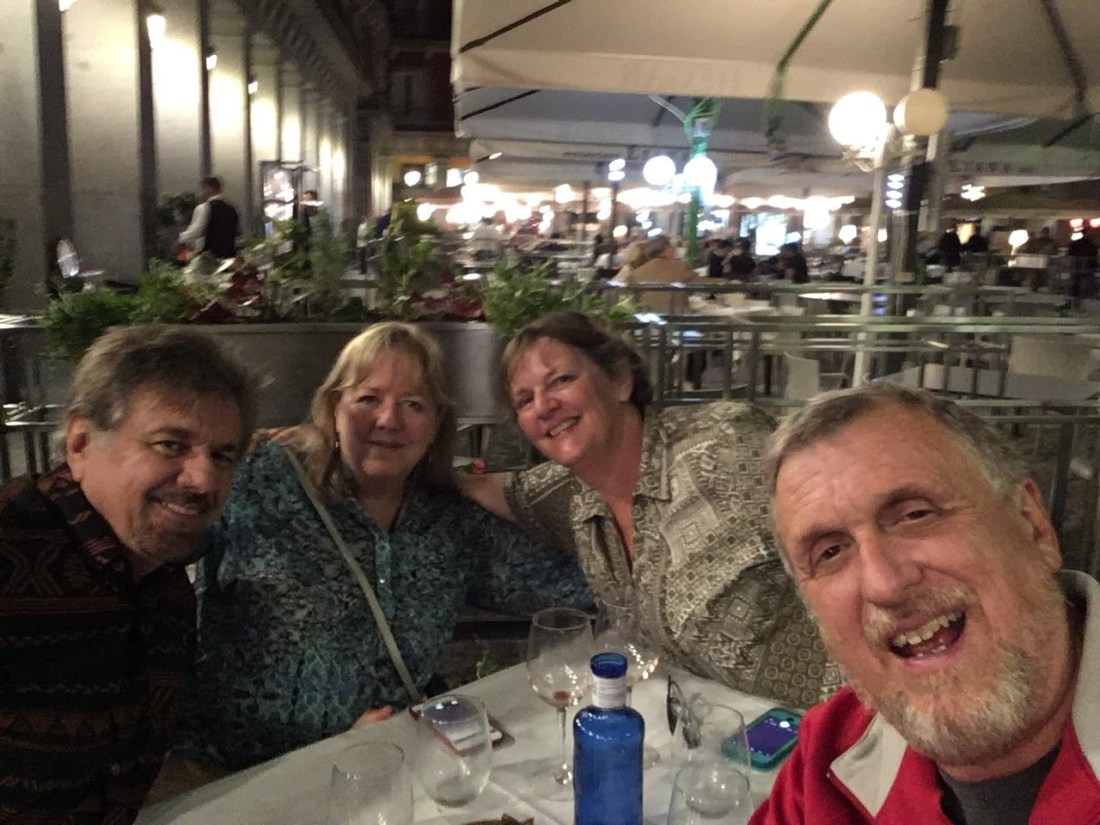
But as the Girl Scout song says, while new friends are wonderful silver, old friends are precious gold. The picture attached to this post is of us having dinner with Len and Nancy Green, friends of ours since the 1980s when Nancy came to Baker & Botts, the law firm where Mark worked. They only practiced together for a few years, but the four of us have remained pals since then. Our kids even went to the same preschool!  Their children, like ours, are grown now, and their daughter is teaching English in Sevilla. Nancy and Len are in Spain to visit Hallie and see some sights, and we were fortunate enough to cross paths in Madrid. Catching up was fabulous, and we closed down the restaurant Tuesday night.

More gold will come our way this weekend. Two friends from Austin, Annette Jones and Susan Spruce, will come on Sunday to stay with us for several days. Susan was one of the first friends I made when I moved to Houston after law school (we’re talking 1983 here), and through her I met Annette, who performed the wedding ceremony for Mark and me. Silver friends became gold, and we couldn’t be more delighted that we get to have them here with us.

Of course, we will have lots of reunions with our US friends this summer. After visits with the kids in the Midwest and dear pals in Oregon, we’ll arrive in Austin in late June and stay till late July. We’ve already scheduled a few dinner dates and such but would love to hear from others who might be up for Tex-Mex or barbecue. Just let us know! We are grateful beyond words for the silver and gold people in our lives.

img_1560

Color my world

img_1308We spent last weekend in England with our friends, the Wallaces. Patrick Wallace and Mark met in 1982 when both guys were studying at Harvard Law School. Thirty-seven years later, Patrick and Frances have hosted us innumerable times at their home in Kent, and we’ve had the pleasure of hosting them in Texas and in Spain. Our daughters, Jane and Mary, know and like their kids, Lindsay, Callum, and Henry. Our families have shared memorable stays in Florida and in France; in the latter location, Jane and Callum, unbeknownst to the parents happily chatting at the other end of the table in the little restaurant on the Left Bank, engaged in a long and truly expensive contest to see who could down the most snails. So we go back a ways together.

On this trip, we spent a rainy Saturday at the Victoria and Albert Museum and then at a hilarious play called “A Comedy about a Bank Robbery.” It’s by the same theater group that created “The Play that Went Wrong,” which apparently everyone else in the world except for Mark and me has seen. Sunday dawned glorious and sunny, though, so Patrick, Mark, and I visited Chartwell, Winston Churchill’s home. The house is delightful, with well-loved, slightly shabby armchairs in the library and more medals than you can count on display upstairs. (Included in this display is Winston’s fencing medal from public school, which I thought was a nice touch.)  But the thing that struck me at Chartwell was how gorgeously green the grounds were. The hedges, trees, and gently rolling hills seemed to me to be the quintessential England.

England has always seemed green to me, despite the silver and glass towers of London and Winifred Letts’s gray spires of Oxford. The parks interspersed among the bustling streets and the verdant countryside are what I notice when we visit Albion. In fact, for me each country has a color. This may be a product of being entranced by a globe that my parents had when I was a kid. I used to spin the globe and stop it randomly with what was undoubtedly a grubby fingertip; then I’d say the names of whatever colored globule of geography I’d landed on. I would say the more straightforward ones out loud: Ireland, Brazil, China, Mexico. But there were some names to be rolled around in your mouth and savored like a candy: Uruguay, Belgium, Afghanistan, Cambodia. And some don’t exist any more; gone forever are Yugoslavia, Czechoslovakia, and Rhodesia. They may not have been much to write home about as countries, but their names were fun to say.

I don’t remember all of the colors on that globe, but countries do have colors for me now. In my geographical palette, for example, Mexico is yellow, probably because I associate it with hot sun beating down on light-colored, baked earth. France is the deep, mysterious blue of the rose windows in Notre Dame. (My mother loved all things azul, so the first time I walked into this glorious building and saw the windows, I thought, “Mom would really like this church! It’s blue!”) China is firecracker red, which I promise is a visual impression of the ornate silk robes we saw on display and not a political commentary. And while I’ve never been to Greece, I picture it as white. That’s from seeing pictures of whitewashed houses clinging to cliffs over the sea and shuffling past a zillion marble statues in various museums. You get the idea.

So what colors are the countries where I spend most of my time? Spain’s easy, and perhaps surprising; to me, it’s Mediterranean blue. Admittedly, most of the country doesn’t front this lovely sea and looks a fair bit like West Texas, which has blue skies and not much else of that hue. Mostly, it’s brown with silver/green scrub. But my Spain is the blue of Mare Nostrum, intense and playful all at once. As noted previously, I spent a fair bit of time zoning out and watching the blue roll by.

Interestingly, the USA is more complicated. Maybe you just never have a perspective on your home nation, because you’re in it and of it in ways that you can’t even begin to fathom. I’m also somewhat at a loss because the last few years seem to have shown us some heartbreaking truths about our country’s racism, misogyny, and greed. At the same time, there’s so much I love about the USA: its physical beauty, its heritage of freedom, its historical optimism and friendliness. Five years ago, I might have told you that my country was a spectacular pointillist painting, with dots of a million hues decorating our canvas. Now I’m not so sure, and we seem more like a black and white kind of place. We seem both less diversely colored and more deeply and contrastingly divided. Let’s hope, let’s pray, that I’ve just gone colorblind.

Jiggety jog

Mark and I returned yesterday from six days in Paris. It is almost redundant to say that we had a great time; it is Paris, after all. We did encounter two glitches, however. First, the weather was crummy. This was not a surprise, as the weather is always crummy when we are in Paris. We’ve been there three times, and twice the weather has been cold and wet, and once it was the hottest week to date in the City of Lights. Second, our Airbnb apartment was sufficiently unsuitable that we spent a grand total of one night there. Problems abounded, but the worst was the “wooden steps” to the loft bed – read, rickety ladder, pictured here. We’re fairly flexible travelers, but we were not willing to call this home for several days and therefore decamped to a hotel. Happily, the hotel was super, and we enjoyed our stay there.

What constitutes home, permanent or temporary, is actually a subject that has been under discussion at our abode lately. We’re extremely fortunate to have an apartment here in Torrevieja and a small house outside of Austin, Texas. Both places are familiar and comfortable, cozy and fun. But are we at home in Spain, or is home always going to be in the US? When talking about our return to the US in about a month, we often speak of “when we go home.” But the apartment in Torrevieja feels like home, too, with its comfy nooks and glorious balcony. Can you have two places that are home, or is it in the nature of home to be one, unique place?

It’s worth noting that I’m being more literal than usual here and identifying home as a physical place. If I were going the poetical/spiritual route, Wordsworth would have answered my question in “Ode on Intimations of Immortality” – “…trailing clouds of glory do we come/From God, who is our home.” Or I could turn to the Bible verses so often read at weddings and identify home as anywhere my dear spouse is. “For whither thou goest, I will go, and where thou lodgest, I will lodge….” Ruth 1:16, King James Version. One problem with that formulation, of course, is that Ruth is talking to her mother-in-law and not to her husband, who is at this point in the story lodging in a grave. Or I could opt for some weird amalgam of quantum mechanics and Jacques Derrida and declare that you can’t really know much of anything anyway, so please pass the wine and the quarkscrew.

The question of where home is has arisen before, of course. I felt very settled in my various dorm rooms and apartments while I was in college and law school at the University of Texas, so they felt like home. But somehow the house I grew up in seemed to have the most claim to the title, and it also annoyed my parents no end when I referred to Austin as home. Maybe it frightened more than annoyed them, because this reference reinforced the reality that the last kid was growing up and creating an independent life outside of the family. Having raised two kids, I understand.

But even though families change and the location of home may get a bit dicey, I think there’s something deep in people that wants to have a place to call home. I first realized this in the third grade, when my lovely teacher, Mrs. Gibson, read our class a book entitled “Home Is a Very Special Place.” Contrary to what you may be thinking, I didn’t find the book inspiring and touching. If I’d known the word insipid at age 9, I would have thought it that. So I totally zoned out instead of listening. Which was fine until Mrs. G finished the book, closed it with a snap, and declared that now we were supposed to write our reaction to “Home Is a Very Special Place.” If I’d known the words holy shit at age 9, that’s what I would have been thinking. How can you have a reaction to something you completely ignored? I needed a plan, fast. What did I know about homes? People tend to like them. So I decided I’d write about my love for my own home and gloss over my total ignorance of what was in the book. I did manage to add a reference to it in the last sentence of my little essay, which was, I still remember, “Home is indeed a very special place.” (I did know the word indeed when I was 9.) Mrs. Gibson gave me an A+ and put the stupid thing on the bulletin board. So that day I learned something about home and about how little our teachers knew what we were actually learning.

Of course I was probably a late bloomer in my realization about the place of home in our lives. We’re told this early and often. Parents sing to their babies about homes. Remember this one? “To market, to market to buy a fat pig/Home again, home again, jiggety jig/To market, to market to buy a fat hog/Home again, home again, jiggety jog.” Later, the Three Little Pigs struggle valiantly to defend home and hearth against the Big Bad Wolf, and Snow White finds a home with the Seven Dwarves and, later, the slightly necrophiliac Prince. We sing camp songs about Homes on the Range (which really puzzled me, because I thought that a range was a stove). References to home pepper our childhoods.

So where does all of this leave me and my question of where home is – Torrevieja, Austin, none or all of the above? Maybe the answer is that home is the place that feels special, so just for today it is Torrevieja, and in a month and change it will be Austin. This is not an earth-shattering conclusion, but the process of musing about the centrality of home in our lives has made me mindful once again of my incredible privilege in having multiple options. How many millions of people in the world have no home, or terrible homes, or have had to flee their homes to save their lives? Just like in Mrs. Gibson’s class, I’ve been ignoring what’s going on around me and focusing inward. So the next time Mark and I talk about home, I’ll try to recall the more serious issues around that word. And maybe if I’m mindful, my eyes might open to ways to help others find their homes, too.


img_1254